Sri Lankan Frogmouth

Early yesterday morning, Gourvjit and I met Saleem and Deepthi, a graphic designer who was collecting information about wildlife in the Periyar, for a trek into the forest. Because Gourvjit and I had recently been with Amie and Milo on a path typically followed from the boat landing–which was where we were meeting our guide this morning–to avoid touring the same land we asked the guide to lead us on a different route. He told us there was one which might yield some interesting wildlife sightings, but that the terrain would be a bit more difficult. We took the challenge, of course.

What our guide had neglected to tell us then, but which we soon realized, was that the route he had planned for us to take wasn’t really a ‘route’ at all. That is to say, to make our way we had to cut through 7 ft tall elephant grass and other underbrush, and we followed no well-worn groove in the dirt, or footpath. But in this manner we carved our way up a hillside, conquering some slippery rocks under foot, to a clearing, from which we could see a broad landscape of savannah hills and waterways.

Yet on the way down from the clearing these minor travails were justified as, after tramping through another patch of thick grass, our guide told us to be still while he pointed to what looked like a lump of tree–but with eyes. Deepthi whispered to me that we were seeing a Sri Lankan (or Ceylon) Frogmouth, a nocturnal bird native to the Western Ghats, whose skill at camouflage makes you about as likely to spot it as one of the Periyar’s 50 tigers. I can say very honestly that I have never seen a bird I was so taken with, with its wide-set and perfectly round eyes, and its blocky, brown, and perfectly rigid form. Because the Frogmouth hides in the daytime by keeping still, we were able to get unusually close to it for a good while before it was threatened and flew off to a tree with thicker foliage.

It was a really unique experience to see this bird, and one I’ll not soon forget. Luckily, Deepthi was able to capture some great shots of the bird. Check them out!

Finca Work

I had more butterfly luck this morning when, exiting the trail from my lodgings onto a dirt road, I spotted a Hamadyas glauconome glauconome, commonly known as the Guatemalan or Glaucous Cracker, on a tree nearby. Although I didn’t know it at the time, the males of this species can create a cracking sound while flying. I had heard this sound from flying insects several times as I biked along the road during my stay here, but had never been able to identify the source. The specimen photographed here was a female, however, because once I got close enough to take the shot, it flew away silently. After breakfast, I was crossing the long suspension bridge that leads to the bungalows and one of the trees next to the railing, whose canopy was roughly level with the bridge, had flowers that had attracted another butterfly. Despite the length of time that the butterfly stayed at the flowers to collect nectar, I have not been able to identify it from the various photos I took, because it never opened its wings to show the markings that would give it away in a guidebook.

However, one animal I have been able to identify is a little lizard that I found while walking a trail. More specifically of the family Polychrotidae, or an anole lizard, the species I was lucky enough to encounter was the indigo-throated anole, Anolis sericeus. I have learned that all anoles have at least some ability to change color, they all have dewlaps, which are cartilaginous frills below the neck, and, like many lizard families, they can relieve themselves of their tail if sufficiently threatened. Fortunately my presence was only frightening enough for the anole to reveal its beautiful frill and, as I approached for a close-up, run off.

When I was done with my little hike, I headed to the finca, where I was to see the recently planted saplings and the cleaning of last year’s crop area. Continue reading

Sea Kayaking

Yesterday afternoon Harvey and I tried kayaking around the cove. Since the waters were very calm once we got past the waves, we decided to also paddle out of the cove and even past the literal Morgan’s Rock, a jagged tooth of rock sprouting from the ocean with a couple tufts of grass growing on it here and there. The Rock is actually part of the neighboring cove even though it doesn’t look it from the Ocotal beach (the ecolodge’s). We sat around for several minutes at a time, just feeling the waves lift and lower us on the water. It is an eerie feeling when you are so low in the kayak that you watch a swell block out the horizon and rise above your head, only to carry you up set you back down as it passes you, not truly a wave until it reaches the beach. Even with these peaceful pauses, the speed with which we were able to reach the rock told me that reaching San Juan del Sur by kayak within four hours was easily possible. After making sure that the next day’s weather would be safe, I made plans to set out early in the morning for SJdS with a fishing boat, the Eco I, as an escort.

*

Today I left the beach at around 6:50AM. It was high tide, and there were many small waves crashing onto the shore and my kayak as I tried to make my way over to the fishing boat anchored a couple hundred meters out. Once I was properly soaked, I got past the waves and greeted the two fishermen, Jacinto and Alejandro, passing them my backpack after removing my large water bottle and sunglasses. Jacinto checked his phone—it was 7:00AM, time to start. I shoved off the Eco I and started paddling.

The monotony of the trip was broken by scenery and “visits” by animals. A needlefish jumped out of the water a couple yards in front of me; frigate birds would start a dive towards the water and suddenly pull up, their prey apparently swimming for cover; over a dozen butterflies (not all at once) fluttered wildly over the waves of the open ocean–a comical sight. I couldn’t help thinking that if I was only a few miles further off shore, I may attract dolphins. However, despite my motored escort boat I didn’t feel safe kayaking out that far, and my job was to determine the duration of a trip to any of the coves south of Morgan’s Rock. Throughout the trip the coastline was a comforting danger—I could easily see the waves crashing violently into the many rocks protecting the shore, so I always maintained my distance from the coast even though there may be less wind to slow my voyage.

Huge rock formations and green forests provided most of the interesting landscape, although I also passed the well-known surfing beach, Maderas (which I will save more details on for a future post) and the Survivor filming site Playa El Toro. While in the open ocean I took two or three breaks of about a minute each to drink some water and stretch my fingers and shoulders, as well as to rearrange the Buff I had put on my left shoulder to block some of the harsh rays poking through the clouds (one of which, by the way, looked stunningly similar to a hummingbird’s head, with eye detail and everything). Once I entered the San Juan del Sur bay, passing the immense US Navy Hospital Ship on my right, the wind picked up to the point that I had to take several more breaks to loosen my shoulders. I had no idea how long I’d been kayaking, but I was ready to ride a wave onto shore and use my legs for a change. When I was a couple hundred meters from the beach, the fishing boat pulled up behind me and dropped anchor. I went ashore and bought the fishermen and myself a drink and some snacks, then kayaked back to the Eco I and tied my craft to the larger one. From leaving the Eco I at Morgan’s Rock to returning to it from the San Juan del Sur shore, the trip had taken two and a half hours.

Our ride back was much more relaxing, and I asked Jacinto questions about potential and current ocean excursion offerings while Alejandro fished and made a comment every now and then. One fun activity that Jacinto mentioned is diving with an air-hose the way it used to be done with huge brass helmets (except now one simply uses a mouthpiece), so I plan on trying that out as soon as possible.

Kayaking in the sea brought back memories of the last time I had a paddle in my hands: while exploring the blue caves in the cliffs of Koločep, an island off the coast of Dubrovnik, Croatia. Although the Adriatic Sea is radically different from the Pacific Ocean, my arm muscles certainly thought the same of the two experiences.

My Search for a Boa Constrictor

Growing up in Costa Rica, I was always interested in snakes. Finding the bones of a tiny garden snake and then a group of baby coral snakes in my back yard generated more curiosity than fear, and being able to hold a baby boa constrictor that my friend had found in his yard was an amazing experience.

Since then, I have read about Burmese pythons invading Florida and looked for opportunities to photograph snakes at every opportunity. Last summer, in Kerala, I was lucky enough to find a green vine snake while hiking, but what I’d really like to find is a boa constrictor, perhaps due to my childhood experiences, or because the species is often held in captivity as pets or zoo attractions and I want to find one free in the wild.

This morning I went on a trail hike with Harvey, and we saw a group of howler monkeys, several birds, and a couple variegated squirrels. But it was towards the end of our excursion that we found a creature worth seeing that wasn’t warm-blooded. As we walked on a dirt road between two rows of tall trees, something large rustled loudly in front of us. On the back of the blur twisting through the grass on the side of the road, I thought I saw markings I recognized. Maybe this was a young boa constrictor! I quickly cut left while pulling out my camera and approached the still-moving snake. It was already climbing a tree, and I managed to take a few shots once it was up in the branches. I could easily see that it was yellow mixed with a much darker color, maybe green or black, but it was quickly clear that what we were looking at wasn’t a boa constrictor, since the yellow was so bright and its head wasn’t arrow-shaped. When we got back to the lodge, Harvey and I carefully reviewed the few pictures and attempted to identify the snake with a few guidebooks. Based on the colors, size, and where we found it, we decided it was a tiger rat snake. Despite our fortune at seeing such a large snake in the first place, I couldn’t help wishing it had been a boa.

Better luck next time.

But my search for the boa constrictor is far from over. Every time I hike I peer into the undergrowth or crane my neck to scour nearby branches. Perhaps I will have more chances at night, since the species hunts nocturnally. I plan on going on a few night walks to find the elusive strangler.

Some details on the tiger rat snake: This black and yellow species eats small mammals, frogs, and birds. It lives in trees or open areas at environmental edges, which is where we found it: at the edge of a dirt road not far from the mangroves and right next to a plot of trees planted by MR guests. When it sensed us, it slid through the grass and up a tree, giving evidence for the guidebook referring to the species as an “astonishingly agile climber,” as well as the Mexican common name voladora, or flyer. According to Twan Leenders, the Dutch herpetologist responsible for “A Guide to Amphibians and Reptiles of Costa Rica,” the tiger rat snake, or Spilotes pullatus, can occasionally “stand their ground when approached closely and employ an impressive threat display. The neck and the front of the body are compressed and sometimes lifted off the ground; the tail tip is rattled simultaneously, creating an audible buzz.” Although this behavior would have presented an awesome photograph opportunity, I’m glad the one we found didn’t feel threatened enough to defend itself aggressively.

The Estuary Part One

The estuary waters are always flat and calm, with practically no current apart from what the wind kicks up, and the OceanKayaks’ sensitivity to motion allows you to maneuver very adeptly around mangrove trees or floating logs. All the kayaks are doubles, but I have only gone out alone in the back, and later the middle, seats, joined either by Harvey in another kayak or by the winged microfauna (who tag along even when Harvey is keeping me company).

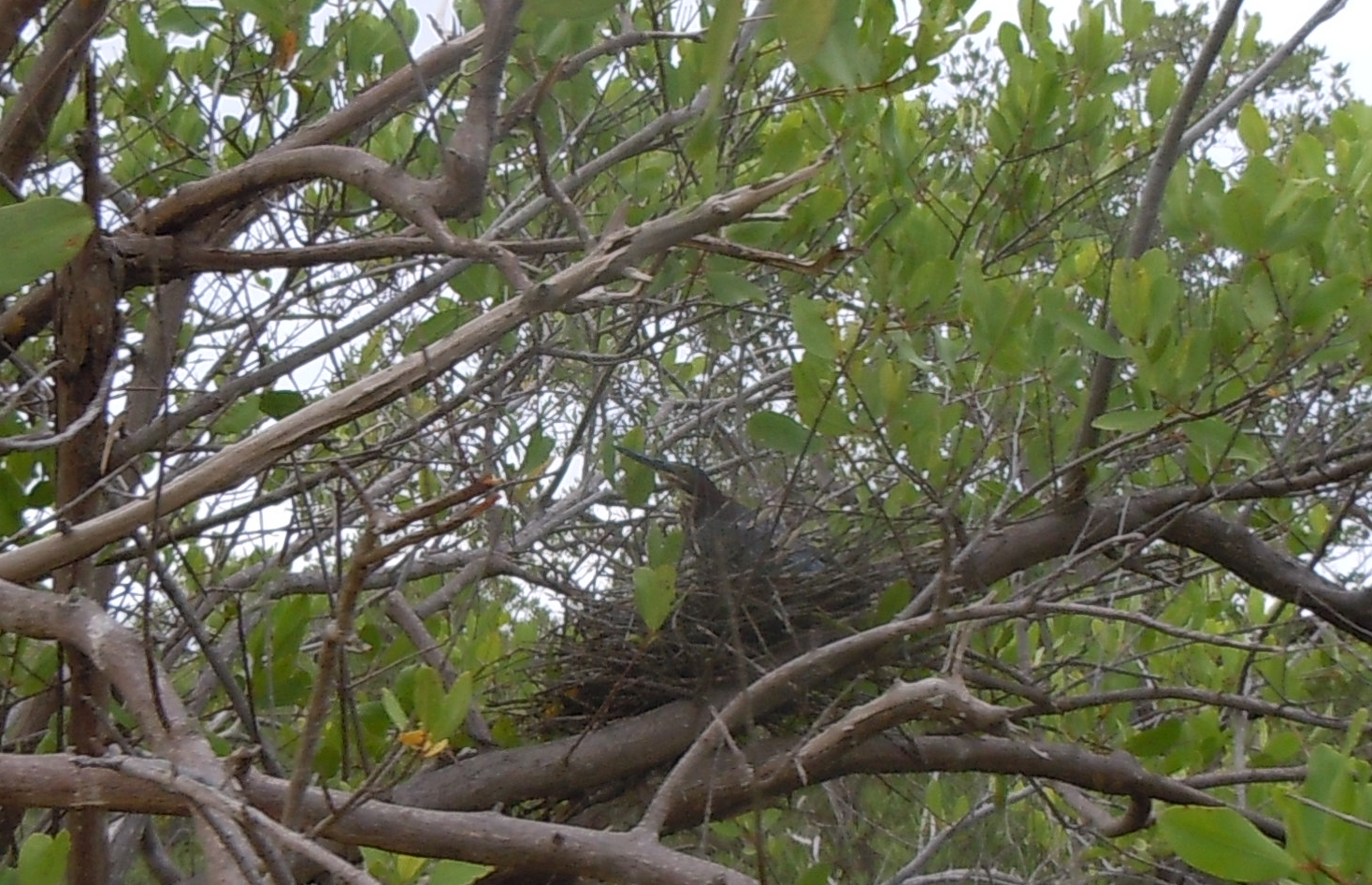
The estuary runs for over a kilometer and a half in a winding path, but there is also a larger open area with mangrove trees dotted inside it. The trees in this wide space are lower and farther apart, allowing you to get up close to the tree and check out the birds’ nests within. A couple times I have been able to see birds sitting in the nests up close, and it is fun to test how slowly you can approach them without scaring them away.

Paddling the estuary is a great activity because you can choose your pace very easily. If you want to take two strokes and then slowly glide along for a minute while looking for birds in the trees, then you can do so, as long as you make sure not to drift too far to one side and bump into a mangrove. If it is already getting dark and the mosquitoes are taking advantage of this fact, then you can see how much of a wake you can leave as you speed towards the beach and watch fish jump out of the water to get out of your way. I generally use the slow and photograph-friendly method on the way in to the estuary, where I can get shots of caterpillars or woodpeckers, and reserve the faster cardio-workout for the way back. I have been thinking about taking a kayak out onto the cove, where the waters seem pretty calm once you get past the first couple waves. I’ve never been on a sit-on-top kayak in the ocean before, so I’ll let you know how that goes.