
Native to the New World Tropics, the Jacaranda (Jacaranda mimosifolia) is an ornamental tree that grows up to 18 meters. The tree is renowned for its clusters of fragrant purple trumpet shaped blossoms that bloom from March to May.
Native to the New World Tropics, the Jacaranda (Jacaranda mimosifolia) is an ornamental tree that grows up to 18 meters. The tree is renowned for its clusters of fragrant purple trumpet shaped blossoms that bloom from March to May.
The wooden block is probably one of the simplest and most played with toys. However, this iconic block did something unexpected: it has been promoted amongst the complex toys of this generation and sure to last for many generations. With a little entrepreneurial conservation, Tegu has created a block that surpasses most expectations of a toy. It is educational and stimulates children’s creativity and unscripted play (as I mentioned in one of my previous posts), is heirloom quality, helps the planet and its citizens, and is so much fun that adults sneak off and play with them.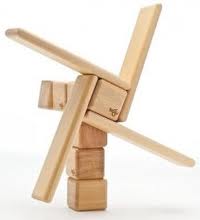
Tegu’s magnetic blocks are built to leave a legacy. They are complex, yet they don’t require any batteries or instruction manuals, just an imagination. The uniqueness of this toy is not just the functional (and inaccessible to children) magnet, but the series of events that follow each block purchase, called the Tegu Effect. Tegu gives every buyer the choice to either donate dozens of trees or donate schooldays for Honduran children. But it is not only the environment and children that benefit; as Tegu grows, the company creates living wage jobs for the Honduran factory workers, and with 65% of the population living currently below the poverty line Tegu offers the people a great opportunity. Continue reading
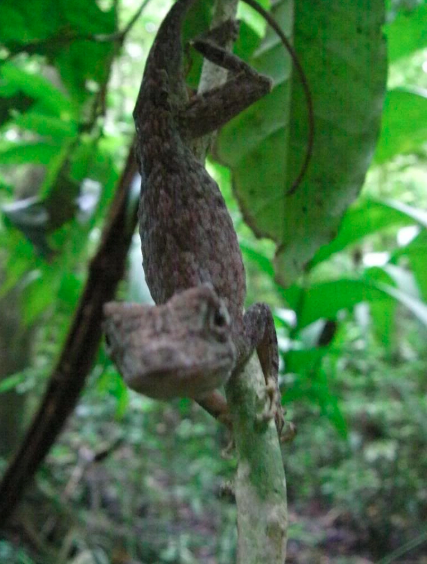
Author’s Note 19/7/11: The lizard pictured at the beginning of the post has been identified as a pug-nosed anole. The first group of stinkhorn pictures (paragraph 2) are of the species Phallus duplicatus, and the second group of pictures (last paragraph) are of Phallus indusiatus. The green mushroom linked to by the word “others” (paragraph 4) is Hygrocybe sp. and the grey/white ones are Psathyrella candolleana. Credit and thanks for mushroom identification goes to Milo Inman.
*
The untouched forest of the reserve at La Cumplida is a hilly cloud forest with few trails and many streams that served as much of our path through the trees. My guide, a local named Santos, and I started in the foothills outside of the reserve and entered the forest by climbing up some steep, muddy inclines.
The protected area amounts to 600 hectares, or 1,482 acres. Santos and I had walked for only about twenty minutes when I spotted the first attraction of the day: some stinkhorn mushrooms. Two were just a white line of pulp, but one was still not fully decomposed and looked as phallic as ever, having lost its veil.
Only around half an hour of hills later, Santos stopped me and pointed out a sapling in front of us. He said some words that I didn’t understand, so I tried looking more closely to decipher his meaning. At last I saw the outline of a faint figure sticking out of the tree’s trunk. I slowly approached and saw that a lizard, perhaps the length of my hand, was grasping the sapling and facing downwards, its scales a mottled variety of wood colors, like a camouflaged chameleon but clearly not of that species based on its head shape. The poor lighting in the forest didn’t allow for the best pictures, but I was glad to get a couple, especially these ones of the lizard curiously raising its head at the closely approaching camera lens.
We advanced further into the forest and saw only the dense and variegated foliage around us
Part of the La Cumplida farm diversification involves growing crops apart from coffee. I’ve already mentioned the tree cultivation and bananas, and here I can go into more detail about the wood production and other harvests.
Ferns cover many of the hills in the upper ranges of the finca. Sheltered under black netting to block out the sun, these billions of fronds are handpicked and bundled in different sizes. The vast majority is sent to Netherlands, but other European countries and the United States receive the ornamental plants as well. Why is Netherlands the main customer? Because the country holds the largest flower market in the world at Aalsmeer, has long been the production hub for the European flower industry, and is a major international floral supplier. Many bouquets contain not only blossoms but ornamental leaves as well, and these ferns work well in many arrangements.
Wilfredo led us through the fern fields and told us a bit about its cultivation. One of the problems they have while growing the ferns is fungal disease, which turns them yellow and brown as they die; fungicide and physical culling are necessary to control the spread. About every two months they have new fully matured fronds that can be harvested, bundled up, washed, and bundled again under bags. Then they are boxed and sent under refrigeration to their destination (if I remember correctly, at 7 degrees Celsius). Below is a short and simple video that includes some of this explanation and process.
Pierre and I went on a tour around La Cumplida’s coffee plantation with Wilfredo. La Cumplida is a huge finca of over 1,600 hectares (this includes 700 ha. for coffee and 600 ha. for protected reserve) situated in the region of Matagalpa, which is very well known for its coffee production. First we went to the processing plant, which is under repair because some of the machines were being too rough on the coffee beans. Despite the fact that none of the machines were currently working, he walked us through the bean process: loading, skinning, washing, and reloading the beans. The drying and roasting takes place at another location. If we had been here any time from October through February, the machines would have been whirring and red beans would come by the truckload to be processed, since over 2000 coffee pickers would be hard at work in the hills, collecting beans.
Below is a video of some of the coffee work we watched. Wilfredo’s explanation of the deshijo is translated in brief three paragraphs below.
I had more butterfly luck this morning when, exiting the trail from my lodgings onto a dirt road, I spotted a Hamadyas glauconome glauconome, commonly known as the Guatemalan or Glaucous Cracker, on a tree nearby. Although I didn’t know it at the time, the males of this species can create a cracking sound while flying. I had heard this sound from flying insects several times as I biked along the road during my stay here, but had never been able to identify the source. The specimen photographed here was a female, however, because once I got close enough to take the shot, it flew away silently. After breakfast, I was crossing the long suspension bridge that leads to the bungalows and one of the trees next to the railing, whose canopy was roughly level with the bridge, had flowers that had attracted another butterfly. Despite the length of time that the butterfly stayed at the flowers to collect nectar, I have not been able to identify it from the various photos I took, because it never opened its wings to show the markings that would give it away in a guidebook.
However, one animal I have been able to identify is a little lizard that I found while walking a trail. More specifically of the family Polychrotidae, or an anole lizard, the species I was lucky enough to encounter was the indigo-throated anole, Anolis sericeus. I have learned that all anoles have at least some ability to change color, they all have dewlaps, which are cartilaginous frills below the neck, and, like many lizard families, they can relieve themselves of their tail if sufficiently threatened. Fortunately my presence was only frightening enough for the anole to reveal its beautiful frill and, as I approached for a close-up, run off.

When I was done with my little hike, I headed to the finca, where I was to see the recently planted saplings and the cleaning of last year’s crop area. Continue reading
The finca connected to Morgan’s Rock, part of the Agroforestal forestry business whose owners also run MR and SM, is in the process of clearing the brush covering a large swath of land where new trees will be planted. The trees are going to be more separated than in the past so that more of them can grow to full potential faster. Some of the previous plantation plots have suffered from underdevelopment as a result of too much competition between cramped trees. As a result, these confined trees grow straight up and don’t mature in width as quickly, staying thin and branching upwards to reach the sun. One of the positive effects of this growth is that the branches are very straight instead of curvy, but there is less wood. Over the years the finca has planted over 1.5 million trees for harvesting, and 100,000 for reforestation.
When I arrived at the new plot of trees, Israel, supervisor of the workers clearing the land, showed me the distance difference between saplings, marked by long wooden stakes in the ground already cleared. There would be about a meter more between each tree and row. He pointed to the plantations on our right and started saying the names of different trees interspersed in the endless rows. “Caoba Africana, roble, cedro.” African Mahogany, oak, cedar. Other semiprecious-wood trees in the plantation are teak and pochote, which is covered in stubby spines from top to bottom. Every now and then I could see a tree with a yellow line painted on it, marking it for cutting in the coming months. Israel told me that at the moment they are culling about 20% of each tree plantation to promote the growth of healthy trees and cultivate wood for Simplemente Madera. This amounts to roughly 500 trees for each plot where healthier trees are busy growing to optimum maturity. A potential project would be following one of the trees marked for culling through the steps of cutting, processing, preparing, and buying; in “The Omnivore’s Dilemma,” Michael Pollan followed a calf from youth through fattening, slaughtering, processing, and the final consumption.
“Simplemente Madera,” which means “just wood,” is a Nicaraguan sister company to Morgan’s Rock that primarily uses sustainable wood sources—one of them is the tree plantations at Morgan’s Rock—certified by SmartWood according to the criteria set by the Forest Stewardship Council, an international NGO that sets standards for sustainable forestry worldwide. Providing furniture and architectural services, the company helped design and furnish Morgan’s Rock, and provided most if not all of the woodwork in several Nicaraguan houses and hotels.
Collaborating with the World Wildlife Fund and International Finance Corporation, in 2005 SM worked with a Nicaraguan indigenous community to develop the inspiringly magnificent One Tree program influenced by a similar project in the UK. SM is also attempting to salvage wood felled by Hurricane Felix and provides wood and carpentry services to the eco-surfboard company Ocean Green (which now offers 15% off your surfboard if you book a stay at Morgan’s Rock).
Based on fairly thorough browsing, the SM website hasn’t been updated since 2008. Keeping the information current would help make SM a more relevant member of the online carpentry community and generate further popular publicity for Morgan’s rock.
 Organikos
