Naughty Behavior Will Not Be Tolerated

Thanks to the Guardian for the latest story in this series. We have avoided adding our voice to the many rightly concerned about the radically pro-extraction, carbon-freewheeling policies of the United States since early 2017. The concern is loud and widespread. We have listened. Today, reading this story, I pictured a naughty boy, a bully, getting away with bad behavior for an extended period. Any period of bad boy behavior is intolerable but it happens. Until it is no longer tolerated. Which eventually always happens. And that may be the best stand-in for optimism these days:

Lost lands? The American wilderness at risk in the Trump era

Exclusive: a new study reveals the vast extent of public lands being opened up to the energy industry. The Guardian heard from three communities on the frontlines

by Charlotte Simmonds, Gloria Dickie and Jen Byers

3872 (2).jpg

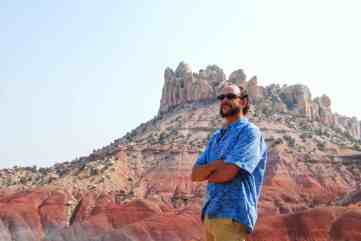
Colter Hoyt, an outdoors guide and conservationist, at Grand Staircase-Escalante. Photograph: Charlotte Simmonds for the Guardian

In the great expanses of the Grand Staircase-Escalante national monument, the silence hits you first. Minutes pass, smooth and unbroken as glass. The smallest sound – a breath of wind, a falling rock – can seem as loud as passing traffic.

Colter Hoyt knows this landscape well. As an outdoor guide, he walks the monument almost daily. Yet these days he is full of fear. This remote paradise of red rocks, slot canyons and towering plateaus faces an uncertain future, following a controversial presidential proclamation that removed 800,000 acres from the monument and opened land up for potential energy development.

When Trump took office in 2016, he promised the energy industry a new era of “American energy dominance”. This would only be possible by exploiting America’s 640m acres of public land: mountains, deserts, forests and sites of Native American history that cover more than a quarter of the country. Continue reading
Op-Ed: US National Protected Lands at Risk

From the New York Times, president of the Wilderness Society Jamie Williams writes an opinion editorial titled “Don’t Give Away Our Wildlife Refuges.” Perhaps given the global crisis I read the final word as refugees accidentally, so I was expecting something else entirely – maybe animals that are displaced by climate change. Instead, I learned that there is a relatively strong segment of the US Congress and state legislatures that are constantly trying to undermine the country’s system of public protected lands, sometimes in ways that could lead to the park or refuge’s destruction:

Tucked into the fiscal relief package for Puerto Rico this spring was a provision to give away a national treasure that belongs to all Americans — 3,100 acres of the Vieques National Wildlife Refuge. The proposal had nothing to do with the economic recovery of Puerto Rico. But it would have handed an important victory to extremists in Congress and state legislatures who want to grab national lands and turn them over to the states to be sold or leased.

Continue reading

Deep Ecology, American Roots: Part 3

I left off my Part 2 post with the claim that environmental groups adopted a shallower ecology as they became more mainstream. I will continue to discuss this below, and focus on a more radical fringe environmental group.

With wider supporter bases, the largest and most influential organizations—The Group of Ten—tended toward demureness while working with the US government, which in many cases meant acceding to the demands of corporations; none of the Ten showed up to protest the controversial dumping of toxic PCBs in Afton, North Carolina.  When The Group of Ten began to cooperate with (or behave more pragmatically towards) extractive industries, generally the more lucrative variety, many activists found themselves looking for more adversarial policies, and abandoned their positions for more “active” ones.  Many of these people may have considered themselves liberal members of the environmental groups before, but given the dynamics of mainstream discourse, the splinter groups became much more radical.  Here are some examples of frustrated people leaving mainstream groups: David Brower was fired from the Sierra Club and ended up forming Friends of the Earth and two other grassroots organizations; David Foreman quit his job at the Wilderness Society and co-founded Earth First!; Rick Sutherland declared the Sierra Club Legal Defense Fund independent of the Sierra Club to litigate more freely in the name of the environment.

Continue reading