In my last post, I claimed that only a small number of studies have been done on valuating eco-tourism as an ecosystem service. I was wrong. After some more digging around, I’ve discovered that a fair number of studies address this topic, though only a small number of studies actually evaluate specific regions of the world. One of the most interesting reports I stumbled upon was from the Journal of Environmental Management. In 1998, Susan Menkhaus and Douglas Lober, two researchers from Duke University, published a paper that focused on Costa Rican rainforests and their ecotourism value. If you’d like to read the whole thing, it’s titled “International Ecotourism and the Valuation of Tropical Rainforests in Costa Rica.”
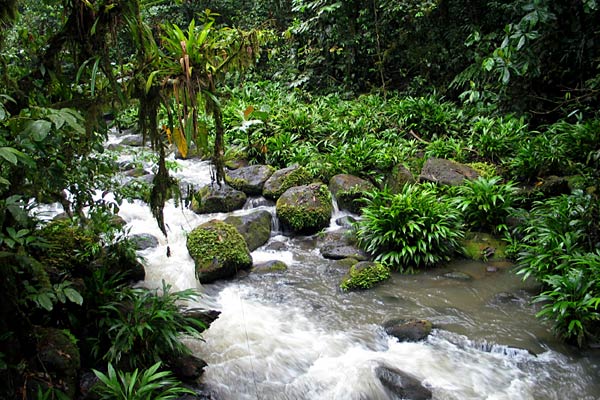
Rainforests provide dozens of ecosystem services. In Costa Rica, they serve the booming eco-tourism industry.
By way of background, Costa Rica is a textbook example of effective management of natural resources, tourism, and integrated public policy. It is widely recognized as the greenest country in the world, and it remains the most visited Central American country. Covering less than 0.05% of Earth’s landmass, Costa Rica contains a whopping 5% of the world’s biodiversity, has 12 different life zones, and boasts one of the highest land protection rates in the world. Nearly half of the tourists that come to Costa Rica engage in some sort of eco-tourism activities. Needless to say, Costa Rica is the best nation to take as an example for this study, which attempts to quantify the value of Costa Rica’s rainforests from a tourism standpoint. Keep in mind, however, that the authors only sought to calculate the eco-tourism value of the rainforests—not anything else related to the forests’ medicinal, timber, or biodiversity value.
I thoroughly appreciated this study because they used the “travel cost method” to assess the value of rainforest ecotourism in Costa Rica. That is, the authors measured how much tourists paid for airfare, hotels, and activities directly associated with their visit (this bodes well for people who are searching for jobs in the hospitality industry). They selected a sample of 320 U.S. visitors to the Monte Verde Cloud Reserve, during a three-month period in 1990. This study is indeed dated, but its methodology is simple and easy to understand, which I like. I also realize that there are a bunch of research integrity-related issues and statistical fallacies that are associated with this method, but the study acknowledges these, and I will not address them in this post. What’s more interesting are the results!
The study found that the average per-person ecotourism value of protected Costa Rican areas was $1150. This number means that, in 1990, the average eco-tourist in Costa Rica was willing to spend $1150 to visit a protected area or rainforest. Multiplying this amount by the number of U.S. eco-tourists to Costa Rica per year, the authors calculated the total value to be about $68 million. They also played around with these numbers to calculate the worth of each nature reserve and how much they should charge for entrance fees.
This study is pretty crude, but I wanted to extrapolate its results just one (even cruder) step further. Assuming that the per-person value stayed constant (which is unlikely—it probably went up), I adjusted for inflation: the average U.S. eco-tourist to Costa Rica would therefore pay nearly $2,000 in today’s money. The country had 2.1 million foreign visitors in 2010. Taking from an earlier statistic from an article in “La Nacion,” I can conservatively say that 45% of those visitors engage in some eco-tourist activities. So here’s the ballpark approximation I’d like to make: today, the eco-tourism value of Costa Rican rainforests stands at $1.89 billion, at least.
I should list out some significant disclaimers. First, Menkhaus and Lober published this study in 1998 with data they obtained in 1990. Tourism growth and discretionary income rates have obviously changed since then. Second, the authors only focused on U.S. tourists who visited Costa Rica for the specific purpose of seeing rainforests and protected reserves. The numbers do not take into account other international visitors or those who come to see other attractions in Costa Rica. Lastly, I, myself, took gross liberty with stretching those numbers with some very bold assumptions.
With all that said, I still think that the authors’ estimate and my extrapolation are very conservative. We did not account for any other kind of valuation: nothing about the dollar value of rainforests as a source of lumber, medicine, biodiversity, filtration, food, or other ecosystem services they provide. Two billion dollars is still a huge amount. The value of Costa Rica’s rainforests reach far beyond tourism, and their true value will likely be impossible to quantify accurately.
 Organikos
Pingback: Paying for Ecosystem Services « Raxa Collective
I’ve been to Costa Rica as an Eco-tourist and learned a great deal thanks to the knowledgeable guides who worked for La Paloma in Drake’s Bay.
That’s a beautiful area of the country! It’s wonderful that you had a good experience there–good guides make all the difference!
Pingback: Voyager’s Dilemma « Raxa Collective