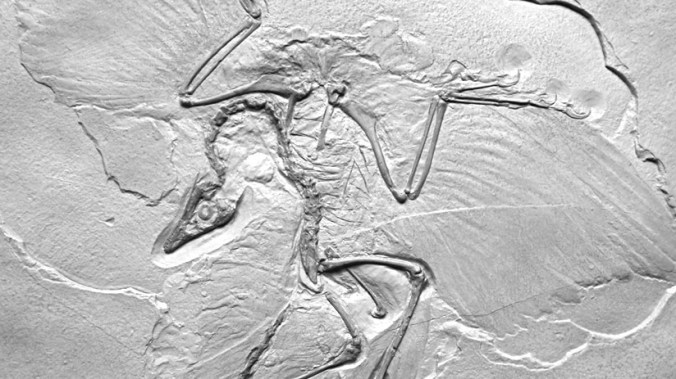
Thor Hanson/Basic Books. Thor Hanson’s own cast of Archaeopteryx lithographica presents what he calls the “ancient wing written in stone.”
Click the image above to go to a podcasted interview with Thor Hanson, author of Feathers:
“To this day, they are the most efficient insulation known. We haven’t been able to match them with synthetics, and I think it boils down to that growth process and the fact that you can make these fine, fine branching structures. The key to insulation is what they call loft — how much air can you hold in a small space? And because feathers are so beautifully and finely branched, they can hold a great deal of tiny, tiny air pockets in that branched structure. And that’s what people try to mimic with synthetics, but haven’t been able to match feathers for that yet, because it’s difficult to manufacture finely branched structures.”
“We do know now that flight came after the feather, and that the early stages of feathers were not aerodynamic. It’s only the most advanced stages in feather evolution that have that aerodynamic structure. But ultimately the result of all of this evolution is an incredible adaptation for flight. If you look at a bird’s wing, it has a particular shape that is similar to the shape you would see if you looked out the window of an airplane, and that is an airfoil-shaped wing with a curved upper surface that gives that wing a bit of extra lift in the air, and a bird wing has that shape, just as an airplane wing does. But what’s amazing about a bird wing is that the individual flight feathers are also shaped like airfoils. …
“So what you get for a bird wing is an airfoil made up of airfoils, and the bird has muscle control over all of those feathers, so it can constantly adapt and change the position of feathers and the shape of the wing to react to any change in air temperature, or wind direction, or air pressure, making it a truly incredible way to fly.”
 Organikos
Pingback: Humans Have DNA For Making Feathers | Raxa Collective