
Because most of the 180 or so members of our organization are based in Kerala, we try to share information every day about the nature, culture and general awesomeness of south India. But some of us have lived elsewhere, and have fond memories of those places. So why keep secrets? Thanks to the website L’Atelier Vert, which is about “Everything French Gardening,” for this article about one small miracle in the Paris neighborhood every romantic favors:
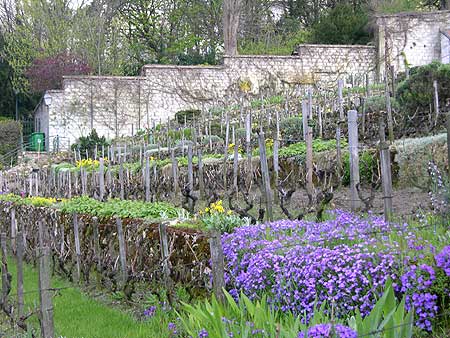
Nestled on the Butte Montmartre, one of Paris’ most secret gardens is its only remaining vineyard. Back in the Middle Ages, this vertiginous hill–like most hills in France–was covered with grapevines. The first vines had been planted by Adelaide de Savoie, the sister of the pope, in the first half of the 12th century. The Abbey of Montmartre, which became one of the richest in France, continued cultivating them and making wine for the profit of the Abbey. In the late 1400’s, ruined by war, the nuns were forced to sell off their land. Commercial winemakers took them over.
In 1576, a sort of prohibition movement was led in Paris by a group of bourgeois merchants. Wines entering the city were heavily taxed, and drinking establishments were harassed. It was at this moment that cabarets, such as the Lapin Agile (still in existence, photo left) and bars began to flourish in Montmartre, which at the time was outside the city limits. At the time, the wine of Montmartre didn’t even need to travel to Paris in order to get drunk! The butte of Montmartre was home to several distinct appellations: Sacalie, Clos Berthaud, Sauvageonne, Vigne de Bel-Air, and the prized Goutte d’Or (Drop of Gold). (These appellations corresponded to various parcels of land, as do all French appellations, not to grape varieties.)
 Organikos