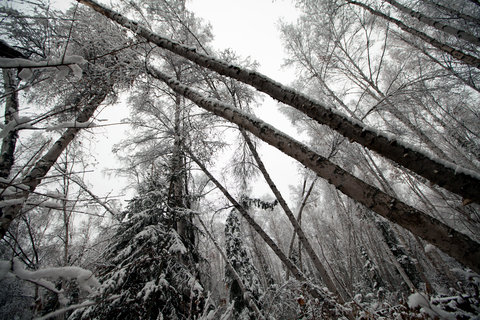
Click the image above to go to this important report, as described in Green Blog. It would seem more pleasant to look away, but we cannot. Anyone who has been to Siberia knows what this is about. If you have not been to Siberia, read on:
The greatest single uncertainty about climate change is how much the warming of the planet will feed on itself.
As the temperature increases because of human emissions, feedbacks could cause new pools of carbon to be released into the atmosphere, magnifying the trend. Other types of feedbacks could potentially slow the warming. Over all, climate scientists have only best guesses about how these conflicting tendencies will balance out, though most of them think the net result is likely to be a substantial rise in the planet’s average temperature.
As I reported last year, one of the most worrisome potential feedbacks involves the permafrost that underlies a quarter of the Northern Hemisphere. Buried in that frozen ground is a lot of ancient organic material, containing twice as much carbon as now exists in the atmosphere. The permafrost is starting to warm and the carbon to escape.
A new report, released Tuesday morning by the United Nations Environment Program, warns that scientists do not have a sufficient handle on the situation. It calls for new monitoring efforts and for a formal assessment of the permafrost feedback by the Intergovernmental Panel on Climate Change, the U.N. body that periodically reviews and summarizes climate science.
The report will be considered in the next few days at a climate negotiating session in Doha, Qatar. If current estimates about the potential for carbon release from permafrost are correct, they mean that tackling climate change is going to be even harder than it once seemed. That is because the long-running global negotiations over emission limits do not take much account of the potentially large carbon release from permafrost.
In essence, the permafrost feedback is a big new emissions source that makes the math of controlling climate change harder than ever.
The new report is available here.
 Organikos