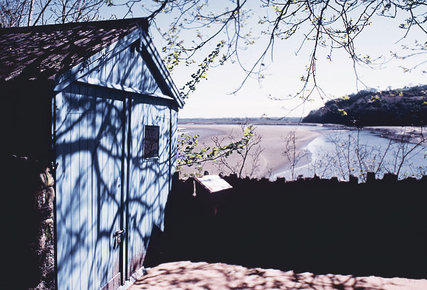
Jonathan Player for The New York Times. Dylan Thomas’s writing shed in Laugharne.
If writers should write, and they should, then where should they do it? Perhaps a philosopher knows best (click the image above to read the full item):
…One does not have to be a Thoreau or a Rousseau for one of these modest spaces to supply what is needed to write. Identification with nature is not required (if indeed it were possible); a certain harmony with nature is already broken by putting pen to paper. And would one really seek harmony with nature if one were privy to the ruthless struggles being played out under every rock? The roof of the cabin, the door, the window are all designed to keep nature at bay. The flat surface of the desk, the laptop screen, the artificial light all bear witness to the necessity to subordinate nature’s spontaneous irregularity, to fashion a little Versailles.
Between world and word there is both a bridge and a chasm. Sometimes it seems that nothing could be more natural than speaking or writing. And yet we know that a manifesto, a book, even a well-turned, well-timed phrase can change the world. Writers are at times, as Pope decried, fools in dunce’s caps. But they can also be magicians, conjuring other worlds, brave new possibilities. The cabin is one culturally powerful image of that semi-detached space in which those creative discontinuities are spawned. It seems to hold a secret, but behind the first there hides another. If the first secret is that to write, one needs a blank sheet of paper, or a blank screen, the second secret, the secret of the cabin, is that one does not strictly need a mountain or a shack at the end of a trail, off the grid. Rather, a table, a chair, somewhere simple, free of distraction. For some, even a cupboard in an office building no-one is using that day will do. But bring your noise-cancelling headphones just in case.
 Organikos
Pingback: Writers Write, But How? « Raxa Collective
Pingback: Writing Places « Raxa Collective