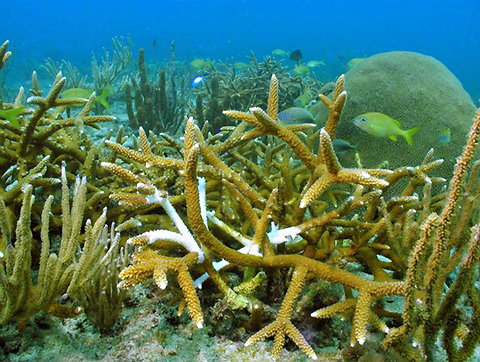
Image: NOAA. Staghorn coral afflicted by whitening, which is associated with ocean acidification and rising ocean temperatures.
We care about both genotypes and phenotypes when it comes to finding solutions to endangerment. And in case you are reading this you should hear the truth: we selected the word phenotype among many possibilities for the post title, mainly for its alliterative value. We need a bit of lingual levity from time to time to balance out the accumulated weight of the days’ environmental news. This particular wordplay is nonetheless a fine fit to the purpose of the story. Thanks to Green Blog for the view on farming as one solution to the various types of endangered coral whose traits, including their morphology and development, may be replicated using techniques from agriculture:
In the international trade in live coral, most of which ships to the United States for ornamental marine aquariums, the source is quickly shifting from wild harvesting to farming, researchers report in a new study.
This shift suggests that, contrary to the conventional view that the live coral trade is a threat to coral reef ecosystems, the buying and selling of corals could help create a powerful incentive for protecting reefs in many small island communities, these scientists say.
“The difference in a year is staggering,” said the study’s lead author, Andrew Rhyne, an assistant professor of marine biology at Roger Williams University and a research scientist at the New England Aquarium.
Particularly in Indonesia, the world’s largest supplier of stony corals and home to more coral reef areas than any other nation, many producers have “learned that if you collect a really beautiful, interesting coral, if you export that, you get to export it one time,” Dr. Rhyne said. “If you keep it and farm it, you get to export it forever.”
Published last week in the Conservation Letters journal, the study comes less than a month after the National Oceanic and Atmospheric Administration proposed listing 66 species of coral as threatened or endangered under the Endangered Species Act.
 Organikos
Pingback: Cats Caught Candid « Raxa Collective