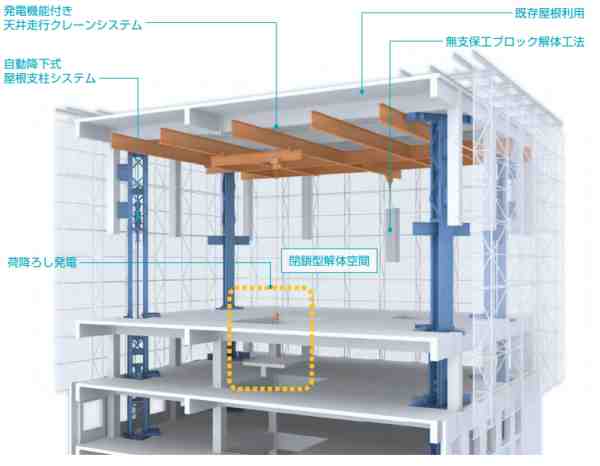
Schematic showing how buildings are disassembled from the inside out. Image via Taisei Corp.
As Raxa Collective continues its work on a historic waterfront building in the Mattancherry section of Fort Cochin’s harbor–currently in the demolition phase of a portion of the property that was built in recent years–we have been doing our homework on methods that make the process as “clean” as possible. We came across EarthTechling, oriented to consumers rather than techno-professionals but with broad and deep coverage of clean tech. This brief article is of interest to our demolition task:
We all know about ways to build greener more energy-efficient buildings, but what about the other side of this coin? Is there such a thing as “green demolition”? Many of today’s small buildings are torn down slowly with wrecking balls and earth-moving equipment. Taller structures are more economically brought down by explosives and gravity, becoming eye-popping media events that bring out the destructive inner-three-year-old in all of us.
But what about big skyscrapers — ones that are 25 stories or taller? At those heights, implosions become hard to control and can generate large fields of toxic debris and dust that can damage other structures. A company in Japan called Taisei Corp. said in this Co.Exist article that it has come up with the “Taisei Ecological Reproduction System,” or Tecorep, which essentially demolishes structures from the inside out, slowly chewing the building down to the ground, floor by floor.
Here’s how Tecorep works: After all of the reusable and recyclable materials are removed from the building, the company attaches a structure with cranes and steel beams around the top floor, fitting snugly like a cap. Then, demolition crews begin cutting holes in each floor, providing an open shaft all the way to the foundation. From there, the highest floor and the supporting walls are then dismantled systematically, piece by piece, and winched down the interior shaft. After each floor is removed, hydraulic jacks slowly lower the cap structure to the next floor and the process is repeated all the way to the ground in a matter of months.
Read the rest of the story here.

