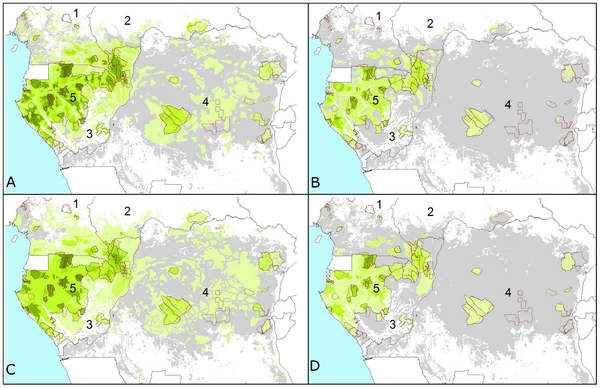
Figure 1. Elephant dung density and range reduction across the Central African forests.
A just-released scientific study documents the destruction. Roughly 25,000 elephants per year are killed in Africa to feed the demand for ivory in Asia, and the pace has increased in the last decade such that, in another decade, extinction is possible. A petition that led to one important-sounding announcement provided momentary hope until it was noted that no dates or even vague timelines were committed to. For now, we have only the clear, cold facts of science and whatever stimulus these findings provide for us to take action:
Abstract
African forest elephants– taxonomically and functionally unique–are being poached at accelerating rates, but we lack range-wide information on the repercussions. Analysis of the largest survey dataset ever assembled for forest elephants (80 foot-surveys; covering 13,000 km; 91,600 person-days of fieldwork) revealed that population size declined by ca. 62% between 2002–2011, and the taxon lost 30% of its geographical range. The population is now less than 10% of its potential size, occupying less than 25% of its potential range. High human population density, hunting intensity, absence of law enforcement, poor governance, and proximity to expanding infrastructure are the strongest predictors of decline. To save the remaining African forest elephants, illegal poaching for ivory and encroachment into core elephant habitat must be stopped. In addition, the international demand for ivory, which fuels illegal trade, must be dramatically reduced.
Citation: Maisels F, Strindberg S, Blake S, Wittemyer G, Hart J, et al. (2013) Devastating Decline of Forest Elephants in Central Africa. PLoS ONE 8(3): e59469. doi:10.1371/journal.pone.0059469
Editor: Sergios-Orestis Kolokotronis, Fordham University, United States of America
Received: May 28, 2012; Accepted: February 18, 2013; Published: March 4, 2013
Funding: For funding of the survey work the authors thank (in alphabetical order) Nancy Abraham, the African Wildlife Foundation, Beneficia Foundation, Busch Gardens, Columbus Zoo, Conservation International, Daniel K. Thorne Foundation, Diane Fossey Gorilla Foundation International, Espèces Phares (European Union), Ecosystèmes Forestiers d’Afrique Centrale (ECOFAC), Fauna and Flora International, Frankfurt Zoological Society, IUCN Netherlands, John D. and Catherine T. MacArthur Foundation, KFW, LifeWeb (Spain), National Fund for Scientific Research (FNRS, Belgium), Offield Family Foundation, Operation Loango, Prince Bernhard Wildlife Fund, RAPAC, The Arcus Foundation, The Aspinall Foundation, The Born Free Foundation, The Institute for Biodiversity and Ecosystem Dynamics at The University of Amsterdam, The Jane Goodall Institute, The Liz Claiborne and Art Ortenberg Foundation, The Lucie Burgers Foundation, The Wasmoeth Wildlife Foundation and Karl Ammann, Total Gabon, United States Agency for International Development (USAID CARPE), USFWS Great Ape Conservation Fund, USFWS African Elephant Conservation Fund, Wildlife Conservation Society, World Wildlife Fund and the Zoological Society of London. The funders had no role in study design, data collection and analysis, decision to publish, or preparation of the manuscript.
 Organikos
Reblogged this on Ann Novek–With the Sky as the Ceiling and the Heart Outdoors.
thanks for posting this! It is really scary that even countries like Gabon, where wildlife protection is a national objective, suffer from elephant poaching
Pingback: Conservation Literacy | Raxa Collective