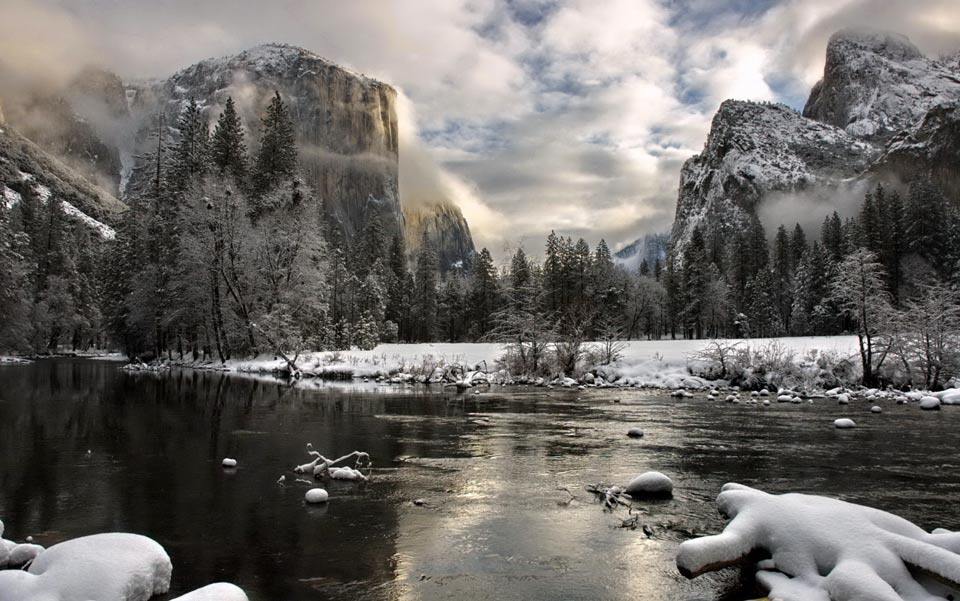
Sunrise over the Merced River after a winter snowstorm, Yosemite National Park, California. Photo by Flickr/Getty Images
Listen to the description of Yosemite in the words of someone who knows:
I sit in an alpine lake basin and eat my lunch: cheese and crackers, lemonade, and an apple. I lay my head on my knapsack, which is almost an extension of myself. I have had it for a long time, and thanks to all of the food I have carried in it, it is an odoriferous repository of memory of peaks climbed and meadows traversed, of the sounds of meadow thrush in canyons, of canyons idled in to feel sunlight and wind on skin, to see the waning light of day and the starry light of night, and be bathed in the ambience of alpenglow. The sounds of gurgling streams — like Beethoven’s Ninth Symphony — banish all worry from the human soul.
I am acutely aware of forgetting because, after 15 years, this is my last day as a ranger-naturalist in Yosemite, and there is much I want to take with me when I leave. So I drink the light washing through this lake basin because my thirst for memory cannot be quenched. I thirst to be free from memory’s limits, which make things in Yosemite (and everywhere) ephemeral.
In Reason in Religion (1905), George Santayana struggled with the problem of how the things and experiences we witness might be made less fleeting and more enduring. Santayana thought the ephemeral, which all things are, could be made lasting by the endowment of memory, at least until our own mortal end. In Memoir From Antproof Case (1995), Mark Helprin said that the ephemeral can be made to last through devotion to that which has been loved, and that this requires the obstinacy of memory.
I want Santayana and Helprin to belay me against the inevitability of ephemerality, a plunge into things I have witnessed in this place manifest by light. I want this day along with all days in the Sierra to be fixed on the emulsion sheet of my mind.
While a ranger-naturalist, I was often asked what I most liked about Yosemite. ‘Light,’ I said. The Native Americans, who named a large part of what is now Yosemite ‘Pywiack’, meaning ‘Lake of the Shining Rocks’, knew that the permanent essence of this incomparable place is light. And the light makes Yosemite untrammelled and bright with no deprivation of freedom or imposition of convention, worthy of lasting memory. As the Italian poet Cesare Pavese wrote:
“At times it returns, in the motionless calm of the day, that memory of living immersed, absorbed, in the stunned light.”
Yosemite is an ephemeral place. Partly it is ephemeral in the original, Greek sense, meaning lasting for a day. Horsetail Fall in golden hibernal sunlight is seen in an early winter sunset when snowmelt and cloud cover are just right, and then disappears with no certainty about when it will return. Mayflies unpredictably swarm one day for several hours above Mildred Lake before their short adult life is spent. An early morning shaft of sunlight on a yellow monkey flower in a dark forest becomes a golden splotch of beauty, only to disappear because the sun changes its angle slightly. A Sierra wave forms after an early evening rain shower, layers of pink and orange and red and magenta spread by an enormous cloud along the Sierra crest, slowly giving way to darkening ripples by the approaching night. A seasonal flood alters riparian vegetation. The soft touch of the skin of a woman I fell in love with while lying beside her near a small stream beneath Medlicott Dome is remembered too, albeit barely. And while I remember the smell of my fellow ranger-naturalist Carl Sharsmith’s baked beans, which he cooked for dinner every night in his tent, I can remember only a few of the many stories he told me while he puffed on his old German pipe.
Read the rest of the story here.
 Organikos
Pingback: Willfully Contemplating | Raxa Collective
Pingback: The Pastoral Muse |