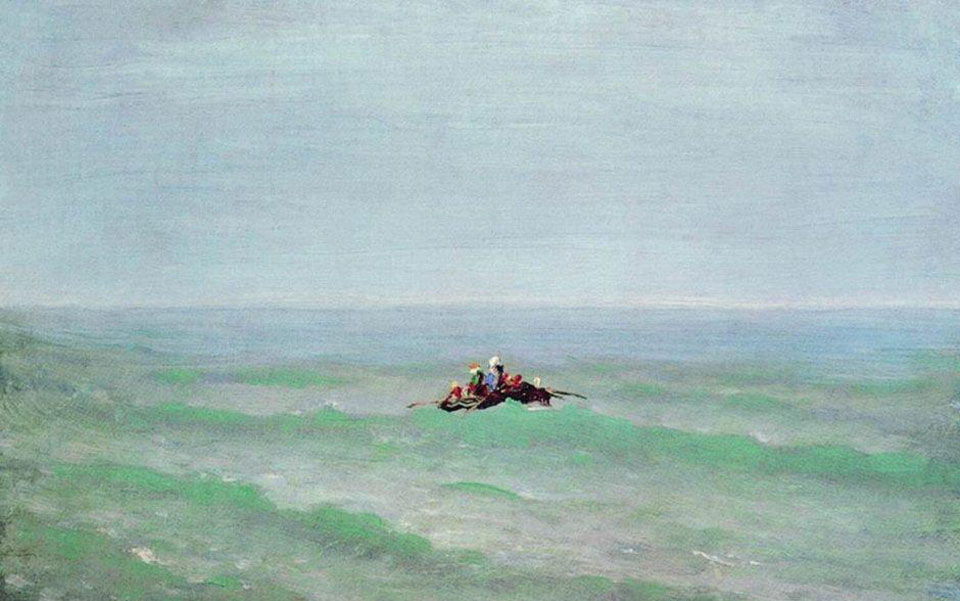
A Boat in the Sea by Arkhip Kuindzhi, c.1875. Oil on canvas.
We tend to favor action as a general rule on this site, but without contemplation where would we be? Two choice paragraphs from a recent philosophical musing in one of our newly favored and now reliably interesting online publications:
…After three years, I was no wiser than when I started. Did we choose freely? Or were we just victims of larger historical, social and biological forces? It was impossible to tell. What I did realise was that philosophers had been struggling with such questions for thousands of years, but were no closer to understanding the answer than they were when they started out. Today, the consensus among most modern physicists, chemists and biologists is that free will is impossible — it is simply an illusion generated by a consciousness that is itself illusory. This explanation didn’t satisfy me. After all, if consciousness is an illusion, who is generating the illusion, and who is perceiving it as an illusion? For me, mechanistic determinism — that there is a sort of fated cause and effect at play in the universe, with no room for choice — raised more problems than it solved…
…When I am faced with a difficult choice now, I neither make it nor don’t make it. As Zen teaching has it, I try to await the condition of being ‘choicelessly aware’. At some point, the choice ‘just happens’, in the same way that your breath ‘just happens’, when you’re not thinking about it. Let your brain do the work without interference, just as you let your liver or your heart do their jobs without interference. Don’t let your ego — your centre of conscious reflection — get in the way. In other words, you are trusting ‘nature’ — or if you prefer, your unconscious — to make the choice for you. Nature is not always to be trusted, but it is a better bet than so called ‘rational action’; it contains a wisdom that is far deeper than reason….
It is not fair to quote randomly from such an article, of course. Please read the whole article here.
 Organikos
Pingback: The Pastoral Muse |