
New research shows that cabbage, carrots and blueberries are metabolically active and depend on circadian rhythms even after they’re picked, with potential consequences for nutrition. Photo by Flickr user clayirving
Smithsonian has an article about a surprising natural phenomenon, which may not impact your feelings but should get your thoughts stirred up a bit:
You probably don’t feel much remorse when you bite into a raw carrot.
You might feel differently if you considered the fact that it’s still living the moment you put it into your mouth.
Of course, carrots—like all fruits and vegetables—don’t have consciousness or a central nervous system, so they can’t feel pain when we harvest, cook or eat them. But many species survive and continue metabolic activity even after they’re picked, and contrary to what you may believe, they’re often still alive when you take them home from the grocery store and stick them in the fridge.
The most recent evidence of this surprising phenomenon? A new paper, published today in Current Biology by researchers from Rice University and UC Davis, found that a range of harvested fruits and vegetables—including cabbage, lettuce, spinach, zucchini, sweet potatoes, carrots and blueberries—behave differently on a cellular level depending on their exposure to light or darkness. In other words, these fresh produce have an internal “body clock,” or circadian rhythm, just like we do.
Previously, Rice biologist and lead author Danielle Goodspeed had found that some plants depend on light cycles and their internal circadian rhythm to fend off predatory insects, at least while still in the ground. In experiments, she had noticed that thale cress plants used reliable daily exposure to sunlight as a basis for anticipating the arrival of insects during the day, and were able to build up reserves of defensive chemicals beforehand, during the night.
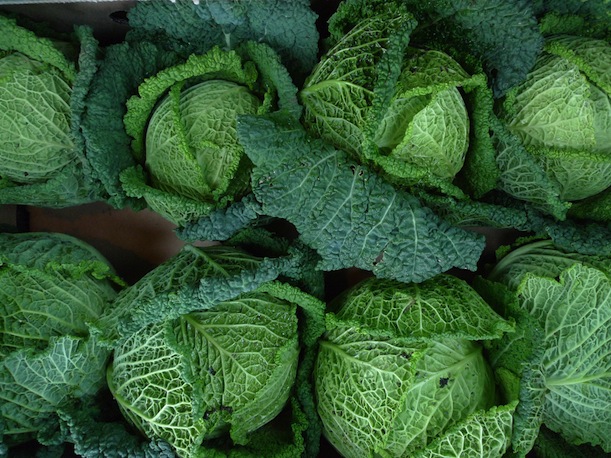
Cabbage, the primary vegetable studied in the experiment. Photo by Flickr user Nick Saltmarsh
In this new study, she and others sought to determine whether already harvested samples of plant species that we commonly eat demonstrate the same kind of circadian behavior. They started by looking at cabbage, a close relative of thale cress, subjecting samples to similar experiments employed to arrive at the previous finding.
The team bought cabbage at the grocery store and took small leaf samples, and also acquired cabbage loopers, small moth larvae that like to feed on cabbage. The larvae were kept on a routine 24-hour light cycle: 12 hours of light alternating with 12 hours of darkness.
For three days, half of the cabbage samples were put on this same cycle, to “train” their circadian rhythms, but the other half were put on an entirely opposite cycle. As a result, plants in this second group would “think” it was night when the larvae behaved as if it were actually daytime, and vice-versa. If the harvested cabbage tissue depended on light exposure in the same way as the planted thale cress, then it’d build up defense chemicals at exactly the wrong time of day, and would likely suffer for it if the pests were given a chance to feed.
Read the rest of the article here.
 Organikos
Interesting , but as we know it everything surrounding us is nature full of living wonderful things . It would be nice however if people felt a bit or at least some remorse for killing other human beings even for no reason at all and or other animals that we often enjoy cooking and eating on a daily basis… Anyways I like these type of post that of course are food for though…no fun intended….
Reblogged this on Myaz_Nuggetz.