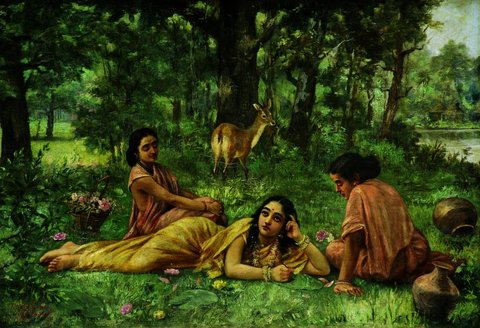
The Shakuntala Patralekhan artwork by Raja Ravi Varma from the Kiran Nadar Museum of Art collection.
Thanks to Aayush Soni at India Ink:
NEW DELHI— In 1881, Sayaji Rao Gaekwad III, was looking for a painter to create his portrait as the newly crowned maharaja of Baroda, a princely state in Western India. As always, he sought the help of his mentor, Thanjavur Madhava Rao, the diwan, or chief minister, of his state, who had held the same position in the princely state of Travancore in southern India from 1857 to 1872.
Mr. Madhava jogged back his memory to that fifteen-year stint, during which he saw how the maharaja of Travancore patronized Ravi Varma, a talented young painter from the state who had honed his skills in the kingdom. He invited Mr. Varma to demonstrate his talents north of the Periyar River.
At the Baroda court, he painted such a delicately detailed and colorful portrait of Sayaji Rao Gaekwad that in 1892 the Maharaja commissioned him to create a series of mythological paintings that were Indian in their essence. Mr. Varma traveled all over India, from his native state of Travancore to Lahore, diligently sketching what he saw.
 Organikos