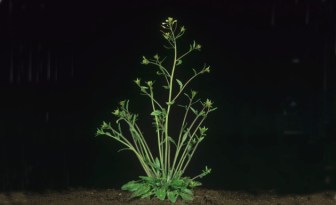
NIGEL CATTLIN/GETTY
Heidi Ledford introduces the following scientific finding on Nature‘s website:
As if making food from light were not impressive enough, it may be time to add another advanced skill to the botanical repertoire: the ability to perform — at least at the molecular level — arithmetic division.
Computer-generated models published in the journal eLife illustrate how plants might use molecular mathematics to regulate the rate at which they devour starch reserves to provide energy throughout the night, when energy from the Sun is off the menu1. If so, the authors say, it would be the first example of arithmetic division in biology.
But it may not be the only one: many animals go through periods of fasting — during hibernations or migrations, for example — and must carefully ration internal energy stores in order to survive. Understanding how arithmetic division could occur at the molecular level might also be useful for the young field of synthetic biology, in which genetic engineers seek standardized methods of tinkering with molecular pathways to create new biological devices.
“This is a new framework for understanding the control of metabolic processes,” says Rodrigo Gutiérrez, a plant-systems biologist at the Pontifical Catholic University of Chile in Santiago, who was not involved in the work. “I can immediately think of applying it to other problems.”
Divide and survive
Plants make the starch reserves they produce during the day last almost precisely until dawn. Researchers once thought that plants break down starch at a fixed rate during the night. But then they observed that the diminutive weed Arabidopsis thaliana, a plant favoured for laboratory work, could recalculate that rate on the fly when subjected to an unusually early or late night2.
Read the whole story here.
 Organikos