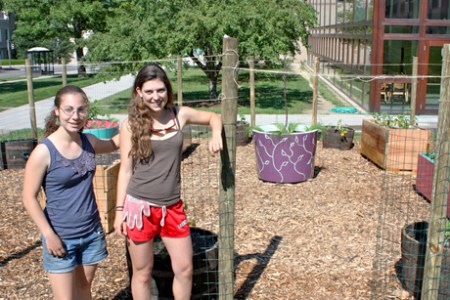
Alex Koeberle. Plant science students Sarah Nechamen ’15 and Celine Jennison ’14 helped create a garden outside Kennedy Hall to demonstrate permaculture.
Diners at Trillium need not look farther than out the window to see where part of their meal originates.
The basil in their pasta or cilantro in their quesadilla may have been plucked from the new garden adjacent to Kennedy Hall, constructed by students last week.
The site will also enable staff and students to stroll around and learn about permaculture – a self-sustaining agricultural system in which herbs, fruits and vegetables are strategically planted so that they work together in mutual benefit. Some plants provide shade, for instance, while others offer pest resistance.
A permaculture garden is essentially a network, with each plant working together, explained plant sciences major Sarah Nechamen ’15, past president of the Cornell Permaculture Club. This increases garden productivity while minimizing waste and human interference.
“Permaculture is a closed system,” said Nechamen. “We want as little input as possible.”
Other learning gardens nearby
Steps away from the permaculture garden is the Cornell Garden-Based Learning site, where passersby can learn about cover crops, companion planting, mulching and plants specifically chosen to attract beneficial insects. Tucked between the Plant Sciences Building and the temporary Development Sociology structures, the nine, 3×3-foot raised beds allow researchers to demonstrate how different varieties of vegetables can work together to create an ecological system.Once complete, the Trillium garden will pretty much take care of itself, she said.
Nechamen collaborated with faculty and students to design the layout for the garden, and months of planning led up to the June 18-20 planting, when she joined students and faculty from the Departments of Plant Biology, Landscape Architecture and Horticulture in building a fence, moving topsoil and transferring a variety of plants into large pots and planter boxes.
The site was selected strategically for its sun exposure and central location, said plant sciences major Celine Jennison ’14. The garden also was designed to be easily accessible with gates and ample space between planter boxes that make it easy to navigate. Each planter box, built by students and painted to make them aesthetically pleasing, is named and will have signs identifying individual plants.
Read the whole story here.
 Organikos