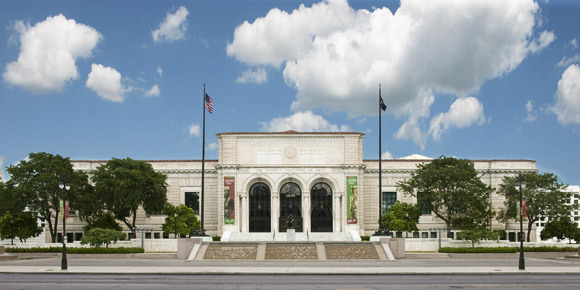
Several contributors to Raxa Collective have family living in Greece. There is nothing to be said here about that country’s economic and political woes that has not already been said better elsewhere, so no insult is intended to Greeks by making reference to the woes of another location. Detroit, an American city facing economic woes comparable, when scaled to the municipal level, of Greece, is considering the sale of art it owns to raise what may be billions of dollars worth of needed cash. Peter Schjeldahl, art critic for the New Yorker, has posted a brief observation about it, the latter portion excerpted below. Out of this mess comes an observation worthy of comment considering Raxa Collective’s mission:
…Art works have migrated throughout history. Unless destroyed, they are always somewhere. It’s best when they are on public display, but if they have special value their sojourns in private hands are likely temporary. At any rate, they are hardly altered by inhabiting one building rather than another. The relationship of art to the institutions that house and display it is a marriage of convenience, with self-interest on both sides, and not an ineluctable romance. I demur from the hysterical piety, among many of my fellow art folk, that regularly greets news of museum deaccessions—though I do wish museums would have the guts to abjure that weasel word for selling things off. (Paging George Orwell.) A museum may thereby maim itself; but the art takes no notice. Protest as we should a local institution’s short-sighted or venal behavior, we must admit at least a sliver of light between such issues and art’s immemorial claims on our solicitude.
The clincher for me was voiced by a spokesman for the state-appointed emergency manager Kevyn D. Orr. Caplan-Bricker commendably quotes it, from the Times: “It’s hard to go to a pensioner on a fixed income and say, ‘We’re going to cut 20 percent of your income or 30 percent or whatever the number is, but art is eternal.’ ” To expatiate:Vita brevis, ars longa. Art will survive. The pensioner will not. I do not view the impending decision as a close call.
Read the whole post here. First, it seems worth noting the difference between what he says, and for example the looted marble adornments of the Acropolis (which sit in London, and are even renamed after the looter, Lord Elgin). At least, we presume that this art critic would agree with us that those marble objects are not merely beautiful as art, but are cultural patrimony of Greek civilization. That is, not there for the taking even in the worst of economic times. The Acropolis does not belong at auction, nor deserve deaccession by any other means, to resolve Greek crises.
In that sense, cultural patrimony–even movable pieces of it–are more akin to natural patrimony, which cannot be moved in most cases. But paintings? Sculptures? Whole collections of art? That seems to be another matter. There are public and private solutions for those which, while full of important questions can be prioritized along with the needs of citizens for succor. Patrimony is to sustenance what art is to succor? Maybe not that simple, but it has us thinking.
 Organikos
Pingback: Reconsidering Deaccession |
Pingback: If You Happen To Be In San Francisco |
Pingback: Art Versus Commerce |