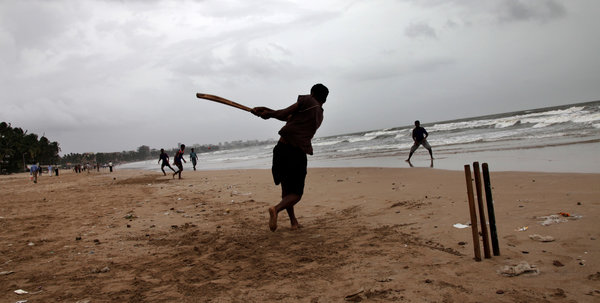
Kuni Takahashi for The New York Times. Juhu beach in Mumbai, India.
The abundant wildlife and traditional culture of India, especially Kerala and its neighboring states in the south, are our most common interests, both on this blog and within the lodging properties we develop and operate. Salim’s brief, daily posts are a mainstay of these interests. Selveraj’s frequent posts capture, in a single snapshot, the uniquely south Indian on-the-road experience.
What we offer less of, for good reason, is an attempt to capture “India” in small snapshots. The quotation marks denote that India is the name of a country, yes, but that it is realistically more the name of an idea; an ideal; any attempt to capture that in a single view or experience is futile because of the complex, diverse and dynamic components.
The book review linked to here (click the image above to go to the source in the New York Times) is worth a read merely to understand that point. To absorb India in macro, if that is even possible, a few key ingredients of culture seem more representative than others. Cricket is critical. Understanding cricket in India seems a necessary (though obviously not sufficient) condition for understanding India in some larger way.
Or so we think, those of us contributing to this site who live and work in India, locally born and bred or recent immigrants as some of us are. This book review highlights our challenge to really understanding where we live and what is going on:
For two months in spring, the Indian Premier League is watched more than anything else on Indian television. Test cricket is played between nations over five days, without guarantee of a winner. I.P.L. matches last three hours and are played between Indian teams owned by businessmen and movie stars. Results are guaranteed. There have been unforgettable moments … Tamasha, the Hindi word for “spectacle,” begins to describe it.
…“The Great Tamasha” is a series of excursions into a cricket-fixated society. For four years Astill, a descendant of a cricketer who played for England in the 1920s, was stationed in New Delhi as the South Asia bureau chief of The Economist. He devotes much of the book to recounting how Indian cricket went from colonial recreation to national addiction, and while treading this familiar ground, the narrative lacks the propulsion of discovery. The sport’s interactions with race, nationalism, religion and caste, for example, have been treated with greater depth and nuance in Ramachandra Guha’s extraordinary social history “A Corner of a Foreign Field.”
Read the whole New York Times review here.
 Organikos
I just LURVE my Cricket PASSIONATELY. :).
I feel the SAME way about Indian Food too. 🙂
Pingback: Cricket, Worship |