
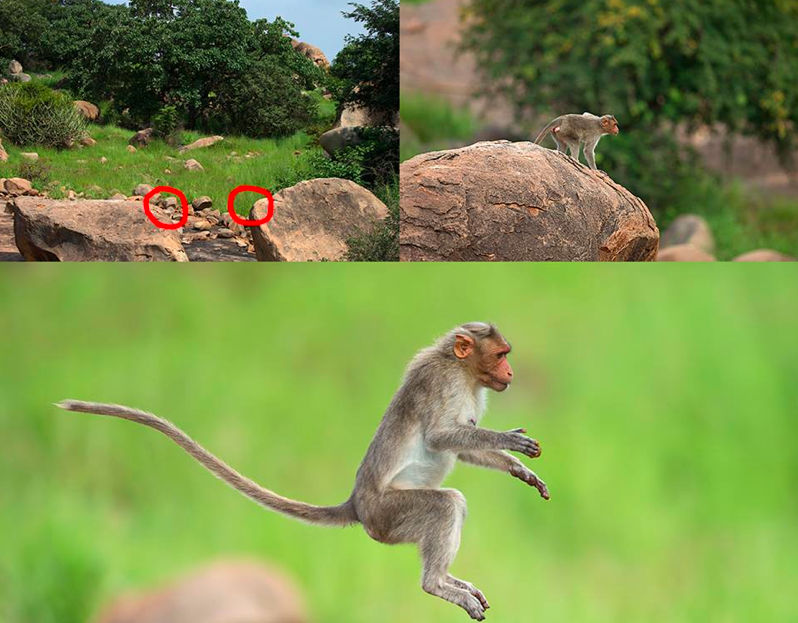
I captured this leaping Bonnet Macaque was photographed at Daroji Sloth Bear Sanctuary near Hampi, Karnataka. Although the photograph represents a split second of activity on the animal’s part, it represents a great deal of thought and patience on mine.
One of the important aspects in wildlife photography is to study the behaviour of your subjects, which will help you in your planning and image making. In this case I noticed the monkeys had a pattern of climbing the left rock and jumping to the right rock to get onto the trees on that side.
Defining the action
Notice the two red circles marked. Once I noticed a couple of monkeys doing this, I knew the rest of the monkeys would take the same path. I have observed this behaviour in many mammals; When the first one in a group finds a path, all the rest follow behind.
Once I studied this, I used a single point focus on the left rock where the lead monkey had jumped off and waited for the next one to appear. With the left rock as the pre-focus point, I recomposed to include both the rocks and waited for the action to take place. Right on cue the monkey appeared and made the leap. All I had to do was shoot in continuous mode to capture a series of images.
These are purely previsualized and planned shots. Life and photography is all about previsualizing and predicting the future. If you can foresee it, you can capture it!
Since I was using a 400mm and shooting at f2.8, I managed to get a good “out of focus” background.
Regarding focusing – You could switch to manual focus to zero in on the rock and wait. Since the monkey was jumping parallel to the frame, there was no issue with depth of field. In my case since I use a back focusing technique, it was as good as manual focus. More on back focus technique later…
Canon 1DX + Canon 400mm f2.8 L IS II, ISO 400, f2.8 @ 1/1250, Evaluative Metering -1/3 Stop.
 Organikos
Great photos. Love it