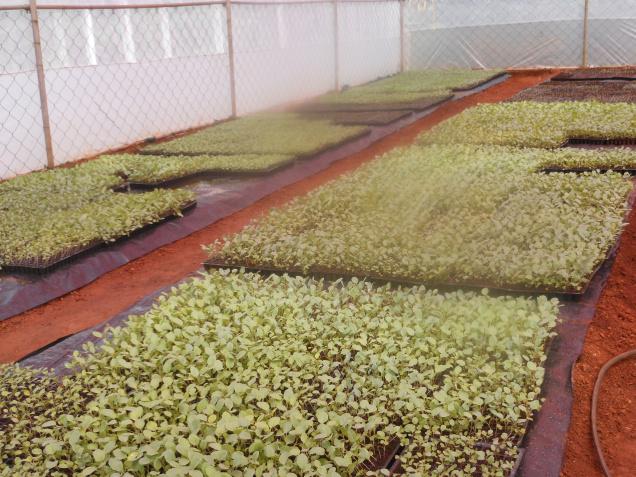
The cool season vegetable nursery of the Seed Processing Plant, Alathur, Palakkad under VFPCK.
Raxa Collective has been on a mission to increase and improve the transparency of our food sourcing since 2010. Already, Cardamom County had established an organic garden and River Escapes had been engaged in local sourcing from fishermen in the backwaters. Milo was the first to suggest we add culinary quality oyster mushrooms to our organic gardens, and he set up the cultivation system there. The next leap forward was the development of Kayal Villa as a quiet retreat set on 6.5 acres of aquaculture and agriculture estate.
Next? Coolness.
‘Tis the season to plant veggies (thanks to The Hindu’s coverage of agricultural issues in Kerala):
The cool season vegetable cultivation in the plains of the district will start next week and end in February.
During the period, the Seed Processing Plant at Alathur, under the Vegetable and Fruit promotion Council, Keralam (VFPCK) will supply 10 lakh seedlings of cabbage and cauliflower to popularise cool-season cultivation using safe methods.
In the last five years, VFPCK had been engaged in the commercial production and supply of cabbage and cauliflower seedlings in the district. The Seed Processing Plant had bagged an order for the supply of 5 lakh seedlings from the State Horticulture Mission. Last year, due to adverse climatic conditions, the desired result could not be obtained, VFPCK officials said. This year, with a good monsoon, the situation is more favourable, they said.
VFPCK had introduced radical changes in production methods this year. Till last year, the seedlings were raised in green houses, a relatively old technology. This year, new poly houses were being used.
The potting mixture used to raise seedlings is a combination of coir-pith supplemented with trichoderma or pseudomonas. Now, perlites and vermiculates will also be used. (Vermiculite is a mineral that holds and absorbs water. Perlites does not absorb water).
This was adopted following the technical guidance provided by Narayanankutty, Scientist, Agricultural Research Station of the Kerala Agricultural University, Mannuthy.
Read the whole article here.
 Organikos