Christian Phillips Photography
The Atlantic has always had excellent coverage of educational issues; environmental issues as well. This article melds the quality of their attention to both topical areas quite well:
‘Nature Is a Powerful Teacher’: The Educational Value of Going Outside
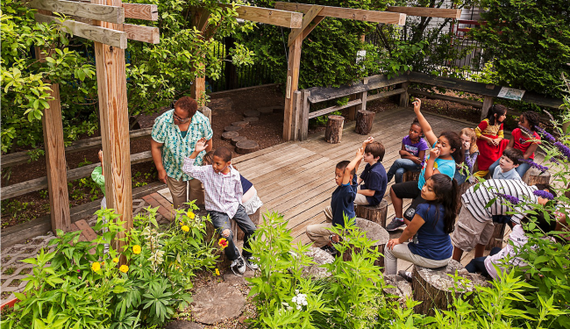
At more than 80 Boston public schools, teachers are moving the classroom outdoors.
Four years ago, the nurse at Boston’s Young Achievers School was overwhelmed. Previously a middle school, Young Achievers had recently become a K-8 school and there was no appropriate space for recess. Instead, according to a teacher at the school, students spent recess in “a disorganized, cracked, muddy parking lot,” where they ran between and bounced balls off of cars.
That changed when a group called the Boston Schoolyard Initiative began a community planning process to build a new playground and outdoor classroom at the school. Today, students spend recess digging in a sand box, crafting tunnels through a bramble, and playing in a stream—and asphalt injuries no longer fill the nurse’s office.
Young Achievers is just one of the 88 schools the schoolyard initiative has renovated since it began bringing green space to urban schools in 1995.Through its partnership with the City of Boston, Boston Public Schools, and the Boston Schoolyard Funders Collaborative, BSI has developed, designed, and constructed outside space at every feasible elementary and K-8 Boston public school.
“Nature is a powerful teacher, and there are so many things that kids can learn hands-on in the schoolyard that they cannot learn sitting in a classroom,” Boston Schoolyard Initiative’s Executive Director Myrna Johnson said.
I talked to teachers at a handful of schools to find out how the outdoor facilities have affected everything from science curriculums to behavior management.
ELLIS MENDELL ELEMENTARY SCHOOL
When the Boston Schoolyard Initiative begins the process of creating an outdoor space, they start by talking to the community about the wants and needs of their teachers and students.
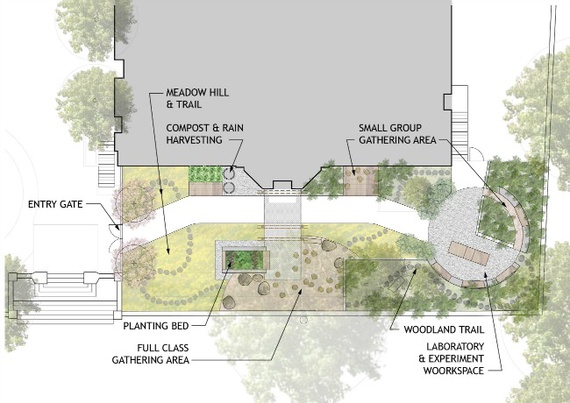
For the Mendell School, Klopfer Martin Design Group incorporated several features, like a lab workspace and planting beds, into the school playground.
Klopfer Martin Design Group
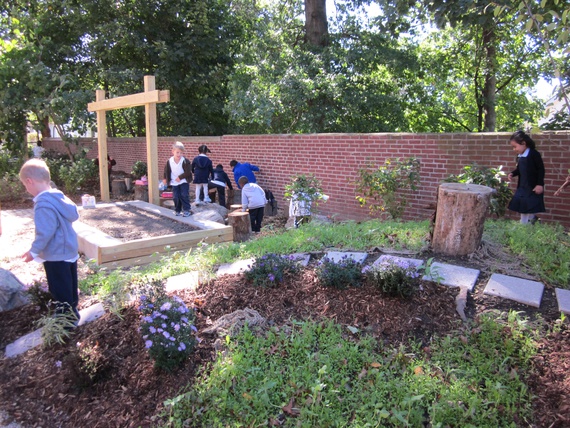
The school’s science specialist Elizabeth Hadley uses the arbor with a pulley system to teach her fifth grade students about simple machines. The meadow and woodland area come into play when she covers ecosystems and food webs. Her second-grade students collect bugs under the logs and then apply lessons from their classroom to determine whether or not those bugs are insects.
Klopfer Martin Design Group
The outdoor space has also become integral to Hadley’s work with a diverse student body. The outdoor space “levels the playing field,” she said, for students from different backgrounds and for students with special needs. “The amount of background knowledge and experiences of going outside and exploring nature that kids bring to the table can be drastically different…Even if they’ve never had any experience before with touching animals or looking for animals in their habitats, they are all doing it at the same time. They can all talk about it together.”
These outdoor experiences can be especially crucial for ESL students, who can use new science vocabulary in its context. “Because students internalize [new vocabulary] best when they are exposed to it in multiple ways, in different kinds of contexts, I find that the language they are using is a lot higher when they’ve had a chance to experience it in multiple settings,” she said…
Read the whole article here.
 Organikos