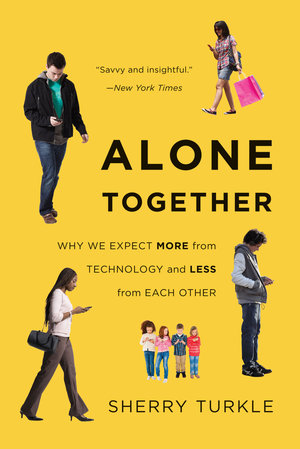
Well over a year ago there was an interview podcast that several of us at Raxa Collective listened to, discussed, and determined to write about, but none of us did. The idea was lost for nearly 15 months. Then, all of a sudden, in the first post today the word conversation appeared in a manner that reminded us of the Fresh Air interview with Sherry Turkle headlined:
In Constant Digital Contact, We Feel ‘Alone Together’
October 17, 2012
The book was reviewed in the New York Times three years ago this month, and together with the interview we just remembered, is still very much worth the while:
As soon as Sherry Turkle arrived at the studio for her Fresh Air interview, she realized she’d forgotten her phone. “I realized I’d left it behind, and I felt a moment of Oh my god … and I felt it kind of in the pit of my stomach,” she tells Terry Gross. That feeling of emotional dependence on digital devices is the focus of Turkle’s research. Her book, Alone Together, explores how new technology is changing the way we communicate with one another.
“The pull of these devices is so strong, that we’ve become used to them faster than anyone would have suspected,” says Turkle, a clinical psychologist and the founder of MIT’s Initiative on Technology and Self. Her research investigates how devices are changing the way parents relate to their children, how friends interact, and why many people — both young and old — keep their devices in-hand all the time — even as they sleep.
As it happens, now that we link to that story from a few months ago, we find not on that Sherry Turkle has been making great headway in stimulating conversation all over the place, but just now the Atlantic is already covering her follow up book:
As we chat, it becomes clear that Turkle is not just not boring—she’s an exceptionally skilled conversationalist. After tea, we take a walk around her Back Bay neighborhood. Throughout our conversation, she occasionally touches my forearm. She speaks deliberately, pausing often. She laughs easily and heartily, a sign more of her warmth than of my wit. She has at her disposal what the best conversationalists have: a wealth of experience to draw from.
Turkle is at work on a new book, aspirationally titled Reclaiming Conversation, which will be a continuation of her thinking in Alone Together. In it, she will out herself again, this time as “a partisan of conversation.” Her research for the book has involved hours upon hours of talking with people about conversation as well as eavesdropping on conversations: the kind of low-grade spying that in academia is known as “ethnography,” that in journalism is known as “reporting,” and that everywhere else is known as “paying attention.”
“I can’t, in restaurants, not watch families not talking to each other,” Turkle tells me. “In parks, I can’t not watch mothers not talking to their children. In streets, I can’t not watch mothers texting while they’re pushing their children.”
Her methods are contagious; once you start noticing what Turkle notices, you can’t stop. It’s a beautiful day, and we walk past boutiques, restaurants, and packed sidewalk cafés. The data are everywhere: The pair of high-school-age girls walking down Boylston Street, silent, typing. The table of brunchers ignoring their mimosas (and one another) in favor of their screens. The kid in the stroller playing with an iPad. The sea of humans who are, on this sparkling Saturday, living up to Turkle’s lament—they seem to be, indeed, alone together.
The conclusion she’s arrived at while researching her new book is not, technically, that we’re not talking to each other. We’re talking all the time, in person as well as in texts, in e-mails, over the phone, on Facebook and Twitter. The world is more talkative now, in many ways, than it’s ever been. The problem, Turkle argues, is that all of this talk can come at the expense of conversation. We’re talking at each other rather than with each other.
Conversations, as they tend to play out in person, are messy—full of pauses and interruptions and topic changes and assorted awkwardness. But the messiness is what allows for true exchange. It gives participants the time—and, just as important, the permission—to think and react and glean insights. “You can’t always tell, in a conversation, when the interesting bit is going to come,” Turkle says. “It’s like dancing: slow, slow, quick-quick, slow. You know? It seems boring, but all of a sudden there’s something, and whoa.”
Occasional dullness, in other words, is to be not only expected, but celebrated. Some of the best parts of conversation are, as Turkle puts it, “the boring bits.” In software terms, they’re features rather than bugs.
The logic of conversation as it plays out across the Internet, however—the into-the-ether observations and the never-ending feeds and the many, many selfies—is fundamentally different, favoring showmanship over exchange, flows over ebbs. The Internet is always on. And it’s always judging you, watching you, goading you. “That’s not conversation,” Turkle says.
She wants us to reclaim the permission to be, when we want and need to be, dull.
She advocates limiting our device usage in “sacred spaces” like the dinner table, the places where phones and their enticements may impede intimacy and interaction. She wants us to look into each other’s eyes as we talk. She wants us to read each other’s movements. She wants us to have conversations that are supremely human.
Read the whole article here.
 Organikos
Pingback: More Conversation Is More Interesting In More Languages |
Pingback: Adding Some Interesting Facts To The Conversation |
Pingback: Conversation, Conservation, Controversy |
Pingback: Conversation, Language Navigation, Identity | Raxa Collective