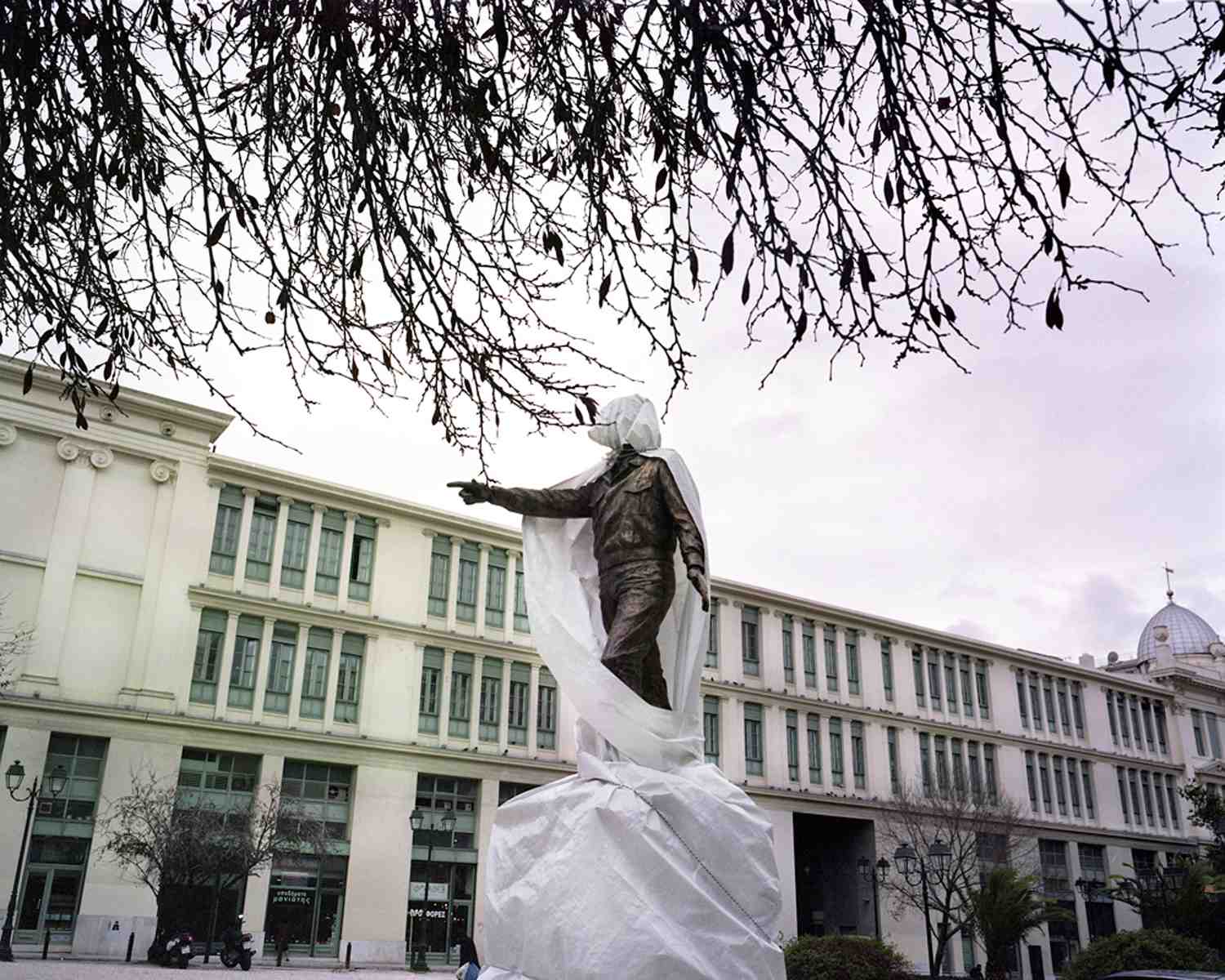
Statue under construction of Alexandros Panagoulis, resistance fighter against the fascist regime. Photograph by Eirini Vourloumis
For numerous reasons, Raxa Collective has deep care for the fortunes of Greece, of Greeks, and especially for the institutions that will move Greece to a better future. In no particular order, a few reasons for this deep care: one of Raxa Collective’s founders entered an immersion language tutorial in Greece for most of 1981, and developed an affection for the place that became a lifelong commitment; the grandmother of two Raxa Collective contributors is from Greece, and so their family in Athens has been living through the unfolding of events the rest of us see as headlines; two other contributors to Raxa Collective met in New York’s JFK airport 30+ years ago waiting to board a flight to Greece, and have made frequent pilgrimages back to Greece to pay tribute to its importance in their lives; several Raxa Collective contributors were recently in Greece tasting organic olive oil from the village where that grandmother is from, and Raxa Collective is currently developing a project to support that organic olive oil initiative.
A blog post by the New Yorker‘s Elissa Curtis brought to our attention today the photography of a Greek who has captured some arresting images that is relevant to us for any and all of the above reasons:
As the economic crisis roiled Greece, the photographer Eirini Vourloumis stepped away from the chaos and found quiet spaces in her home country to tell the story of disruption and decline. She had returned to Greece after eleven years abroad, and she saw it again with fresh eyes. “I wanted to move away from documenting riots and poverty and rediscover the stripped aesthetics of everyday Athens, my memory of which is very clear,” she told me. “This work is an examination of Athens and its role as a physical stage for the economic crisis.”
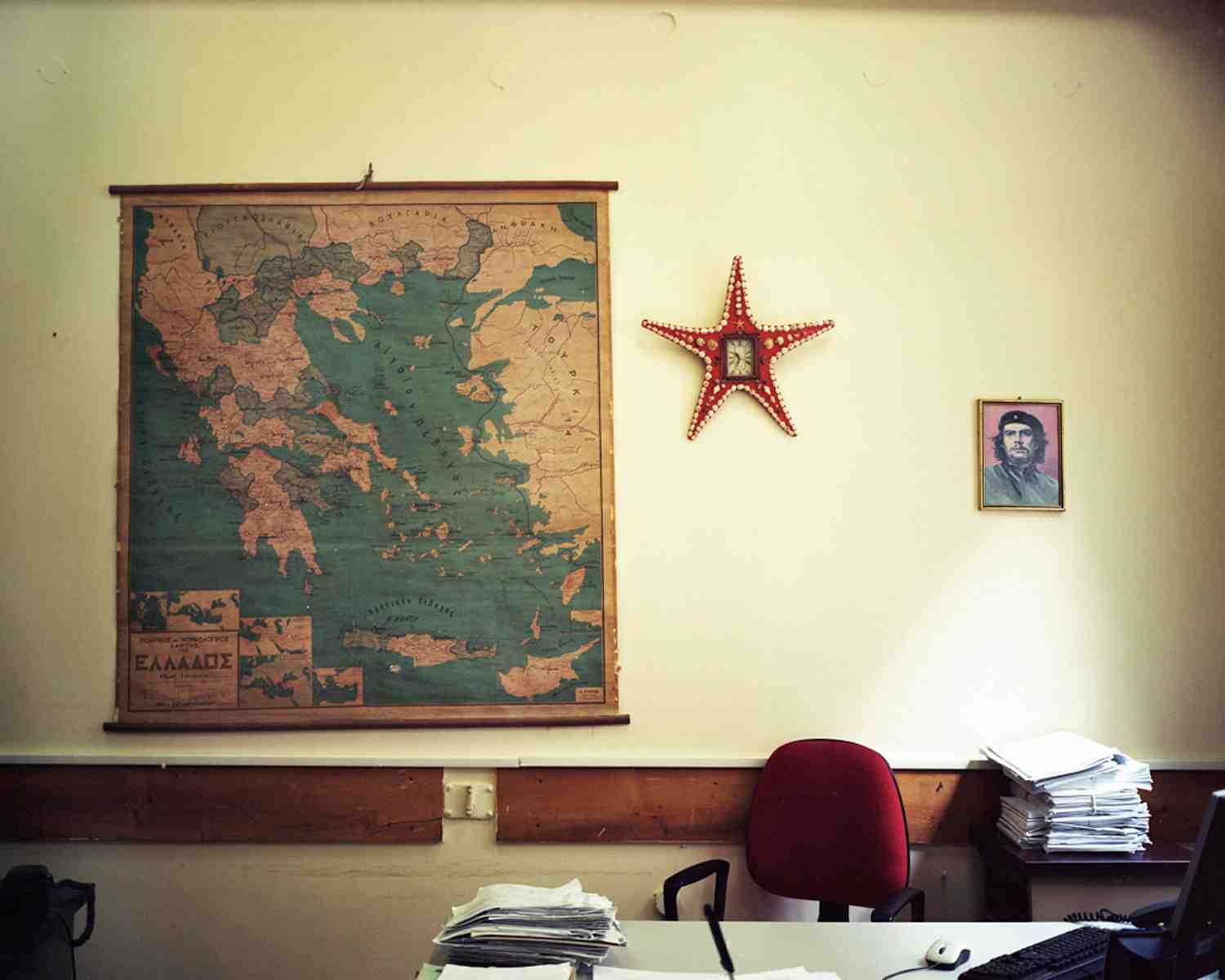
Office, Ministry of Development. Photograph by Eirini Vourloumis
In this series, Vourloumis photographed interiors of government buildings, institutions, and schools to question how these spaces reflect modern Greek culture and character. “Spaces, which once seemed banal or unimportant, now reveal nuances of Greek reality and have social and political implications,” she said. “Like the Greek people, these places exist in anticipation of their future.”

Reception area, Communist party headquarters, KKE Photograph by Eirini Vourloumis
One more reason why these photographs mean something to those of us based in Kerala, India. The image of Che, hanging in the office of Greece’s Ministry of Development, could have been as easily spotted in an office in one of Kerala’s state-level official offices. The strong communist party in Kerala, likewise, makes us think the photo of KKE’s office could have been taken here. We do not know if these are, or are not, representative of the institutions best suited for the improved fortunes of either the state of Kerala, or of Greece. We march to the beat of a different drum, but because we know that Che, Lenin, Marx, the hammer and sickle, and other related images are the source of hope and inspiration for many, we respect them.
Be sure to visit the website of photographer Eirini Vourloumisis.
 Organikos