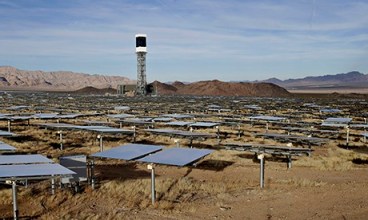
BrightSource Energy’s Ivanpah Solar Electric Generating System in the Mojave Desert. Photograph: Isaac Brekken/Washington Post
It’s not easy being green. Even seeming no-brainers like this solar initiative requires complicated tradeoffs between one environmental objective and another:
…The Ivanpah Solar Electric Generating System will send that power across California, the Golden State, early this year, becoming the largest solar plant in the world to concentrate the sun’s rays to produce electricity. Such utility-sized solar plants are beginning to appear across the US, with 232 under construction, in testing or granted permits, many in the south-west and California, says the Edison Electric Institute, which represents utilities. The scale of the largest plants is difficult to imagine in the eastern part of the country, where a relative lack of available open land and unobstructed sunlight have limited solar facilities to perhaps a tenth the size of the West’s plants. In the west, ample sun, wide-open spaces, financial incentives, falling costs and state mandates have made big solar plants possible…
…But even as the largest plants are helping utilities meet state requirements for renewable energy, the appetite for them may be waning, say experts. The next phase of solar development – especially in the east – may feature smaller projects located closer to cities. Environmental groups want regulators to look at sites such as landfills and industrial zones before allowing construction in largely undisturbed environments such as deserts.
“Part of the beauty is that solar is scalable, literally from the back of a cellphone all the way to a million panels in the desert,” said Rhone Resch, president and chief executive officer of the Solar Energy Industries Association. “The market is still trying to determine what is the optimal size.” The very largest plants, like BrightSource Energy’s $2.5bn Ivanpah system and the Topaz Solar Farm, which will produce current with 9m photovoltaic panels, can generate as much electricity as a coal- or natural-gas-fired power plant.
But there is still a long way to go. In 2012, coal and natural gas plants produced 37 % and 30% of US electricity, respectively, according to the US Energy Information Administration, while wind generated 3.5% and solar just 0.1%.
And the road to big solar energy’s development has been difficult. Lawsuits against the large plants accuse developers and the federal government of spoiling the fragile desert environment and the habitats of wildlife there. On 13 December, the California energy commission tentatively refused to permit another BrightSource project because of its concerns that super-heated plumes of air from the towers and mirrors might harm birds. A small number of singed dead birds have turned up at Ivanpah, according to media reports.
Ivanpah is a “concentrating solar” thermal plant. The better-known variety – like the flat solar panels on homes – convert sunlight directly into electricity via photovoltaic cells. The price of those panels has dropped so low that those plants are much cheaper to build than facilities that use the sun’s heat to turn water to steam. Thermal plants like Ivanpah have advantages – they are more reliable – but their futures may depend on finding some way to store heat so power is available whenever needed.
“The benefit of a thermal solar plant like Ivanpah is it’s not subject to the wild swings in production that a [photovoltaic] plant is,” said Randy Hickok, senior vice-president of NRG Solar, which holds a majority stake in the project. Another major investor is Google…
…The boom was set in motion in 2002, when California told its big electric utilities they would have to generate 20% of the state’s electricity from renewable sources such as sun and wind by 2010. In 2011, the state toughened its “renewable portfolio standard” to 33% by 2020. (Thirty states, including Maryland, and the District of Columbia have adopted such requirements. Virginia is among a handful of states that have set “goals” for the use of renewable energy.)
Companies began proposing to build large plants, many of them on federal land in California’s sparsely populated deserts. In 2008 they were aided by the eight-year extension of a federal investment tax credit available for renewable energy projects and later by energy department loan guarantees and incentives in the federal economic stimulus package. BrightSource received a $1.6bn loan guarantee that was critical to the project, according to Joseph Desmond, senior vice-president for marketing.
The result is the growth in solar power that is plainly visible in parts of the state as well as in Arizona, Nevada and elsewhere. Pacific Gas and Electric, for example, will provide about 11% of its power from solar by 2020, up from zero a decade earlier, Wan said.
In the early days of the rush, the bureau of land management reviewed plant proposals on an ad hoc basis as developers brought them forward. That resulted in some siting decisions, including Ivanpah’s, that environmentalists and conservationists have criticised. In 2012, the agency created 17 solar zones covering 115,000 hectares of federal land in six south-western states, an attempt to steer projects toward areas where environmental review showed the least damage would be done. There are now 19 zones and more than 121,000 hectares of federal land in the programme, according to BLM officials.
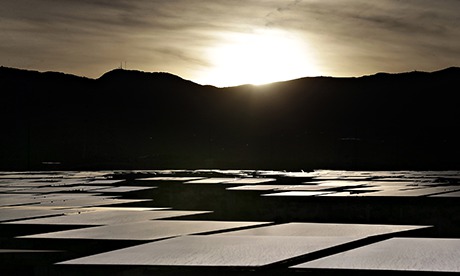
Some of the 173,500 sets of paired mirrors at the Ivanpah Solar Electric Generating System. The mirrors reflect sunlight on to towers that hold water. The heat from the sunlight turns the water into steam used to spin turbines that produce electricity. Photograph: Isaac Brekken/Washington Post
“We are in a lot better place,” said the Sierra Club’s Nilles. “There’s a more orderly process in place.”
At the Ivanpah plant, an initial survey showed that construction would displace only a small number of desert tortoises, but as work began it became clear that many more were living there. The company has spent $56m to build fences and raise tortoises in its “Head Start” pen, where 55 have been born in captivity and will be fitted with devices that allow biologists to follow them when they are returned to the desert. Though two hatchlings were lost to fire ants, Desmond said that the ancient species’ survival rate is much higher under BrightSource’s care than it is in the wild. Responded Connor: “That’s like arguing it’s OK to pave the desert over because we can move all the animals to a zoo.”
To mitigate its impact, Ivanpah’s owners spent $11.4m to purchase and manage 2,800 hectares of habitat for tortoises and other wildlife in other parts of the state.
There is little argument that the project has brought advanced technology to an area of rock and scrub that is home to a golf course, three casinos, some fast-food restaurants and a few stores. Computers guide 173,500 sets of paired mirrors, or “heliostats”, so they can follow the sun for as long as possible each day and generate the maximum amount of heat on the boiler tubes. Eventually, Ivanpah will supply electricity to 140,000 homes.
Robotic devices, controlled by a single person, traverse the rows of heliostats, cleaning the mirrors every couple of months, usually at night, Desmond said. BrightSource, which created the machines, won’t show them publicly.
The plant uses air to cool the water that flows through the boiler tubes. As a result, Desmond said, Ivanpah’s annual water use is the same as just two holes of the nearby golf course.
Read the whole article at its source here.
 Organikos