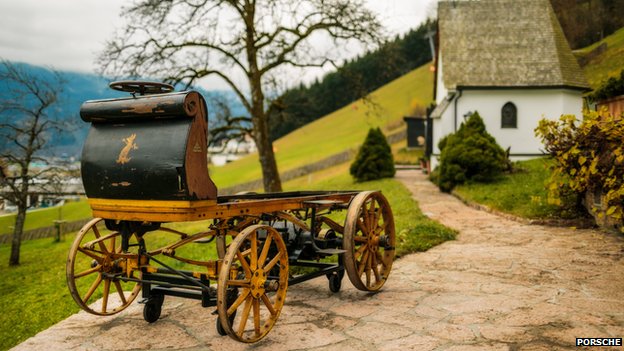
This is the first Porsche-designed vehicle, which had been stored in an Austrian garage since 1902
We are decidedly not the go-to source for information about automobiles, though from time to time we have been known to point out the innovations related to green tech and cars. Thanks to the BBC for their coverage of this intriguing conservation story we might file under cultural heritage, or alternative energy vehicles, or both:
Luxury automaker Porsche has revealed the first car designed by its founder was electric, in a show at its museum in Stuttgart-Zuffenhausen, Germany.
Ferdinand Porsche’s design was dubbed the Egger-Lohner electric vehicle C.2 Phaeton model, or the P1 for short.
The car, made in 1898, was recently unearthed in an Austrian garage, where it had been stored since 1902.
The 22-year-old Ferdinand Porsche, who would start Porsche in 1931, designed the P1 for carmaker Jacob Lohner.
After a trip to the US, Ludwig Lohner, the owner of that firm, became convinced that the age of the horse and carriage was ending, and he asked Ferdinand Porsche to come up with an electric drive train.
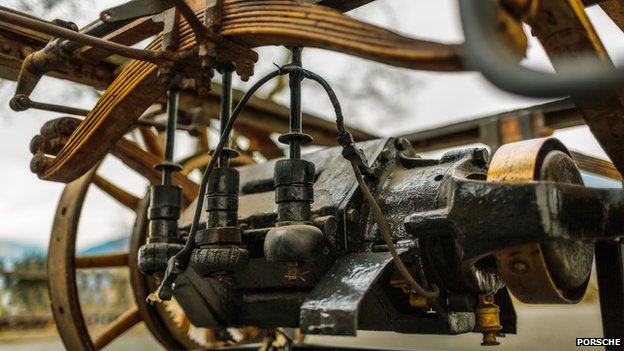
The first Porsche featured a rear-mounted electrical engine which could reach speeds of 21 miles per hour
Ferdinand Porsche designed an “octagonal electric motor” that was powered by electric batteries and suspended amidst shock absorbers in the rear of the vehicle.
Using a complicated series of gears, the car was driven using a 12-speed controller, which had six forward gears, two reverse gears and four gears with which to brake the car.
The P1 took to the streets of Vienna, Austria, on 26 June 1898.
The P1 could reach speeds of up to 21mph (34km/h) and travel up to 49 miles on a single charge.
The car could be styled as an open-air chassis or a coupe.
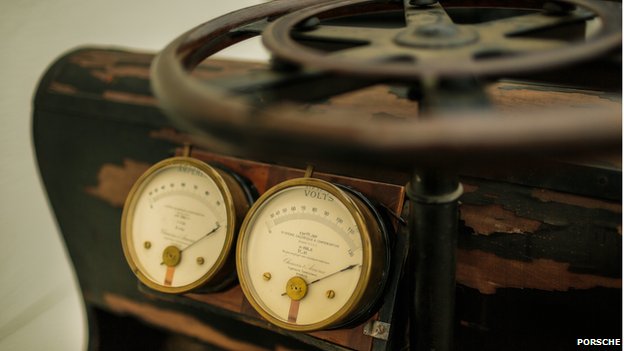
The first Porsche was the most energy-efficient car in an 1899 Berlin road race
Read the whole story here, or listen to the NPR version of the story here.
 Organikos