
(Thinkstock) Is there anywhere left on Earth where it’s impossible to access the internet? There are a few places, but you have to go out of your way to find them, discovers Rachel Nuwer.
As much as we encourage travelers to join us off grid in remote locations, to disconnect and engage in authentic experiences of communities and ecosystems not like home, nonetheless we depend on the grid for our ability to connect with those very same travelers. We are paying increasing attention to the evolution of connectedness, and this report by the BBC is of interest:
It can be easy to forget what life was like before the internet. For many, not a day goes by without checking email, browsing online or consulting Google. Some 1.3 billion people alive today are young enough never to have experienced anything else. Yet has the network of networks underpinning all this activity actually reached every part of the globe?
Various reasons still stop people accessing the internet where they live, of course. There’s censorship, for starters. “We don’t get much traffic from North Korea,” says John Graham-Cumming of CloudFlare, a content delivery network – the equivalent of a regional parcel distribution centre, but for web traffic. “Likewise, early in the Syrian civil war they cut off internet access and we saw a drop in traffic coming from those Syrian connections.”
It’s also a well-established problem that many of the world’s poorest people do not have the means or technology to log on, with just 31% of people in the developing world using the internet, compared to 77% in the developed countries.

The people of North Korea have less access to modern technology than their neighbours, as this night-time satellite image hints. (Nasa)
However, these political and social barriers to access do not necessarily tell us about the physical extent of the internet itself. Assuming you had the right device and the political freedom, is there anywhere left on Earth where the labyrinth of cable and wireless signals does not reach?
Answering this question begins with an explanation of the various tiers of internet access. The primary mechanisms for getting online are wired connections, mobile networks and satellites. Fibre-optic cables make up the core of the internet, criss-crossing oceans and land. The first of those communications cables were put down in the 1850s for carrying telegraph signals. Today they connect all continents except Antarctica, and include many – but not all – small island nations.
Mobile connections, meanwhile, rely on cell phone towers. And these can have an impressive reach. “Two years ago I was in the Sahara, and for quite a large amount of time I had access,” Graham-Cumming says. “It was patchy and slow, but it was there.” Indeed, many developing countries, especially in Africa, rely predominantly on mobile connections for accessing the internet.
Finally, satellites are the slowest means of getting online, but the only choice for those living far from a cell phone tower or wire. The Iridiumsatellite constellation coverage extends over the entire world, and their satellite phones can wire you up in otherwise unconnected places, such as national parks in the US, Antarctica or isolated spots of land like the Cook Islands. “If you live out in the sticks somewhere, it makes no sense for your local telecom provider to run a fibre to your house or farm,” says David Belson, editor of the quarterly State of the Internet report at Akamai, one of the world’s largest content delivery networks. “So in many cases satellite is the optimal solution, although it may not be the fastest one.” Sheer distance explains that delay: from the equator, for instance, data needs to travel about 22,000 miles (35,000km) between satellite and user…
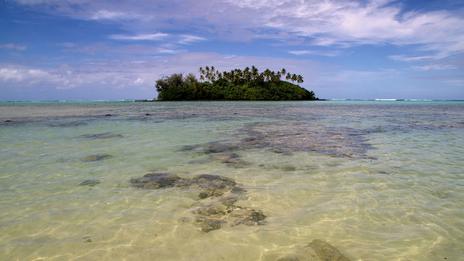
The Cook Islands may not have internet via cables, but people can use satellites. (Getty)
Internet access via satellite is gradually improving, though. A satellite broadband provider called O3b Networks recently launched its first four satellites, which it says orbit around four times closer to Earth than regular geosynchronous satellites and cover a 400 mile (643km) circumference per satellite. This should speed up data transfer by about four times compared to traditional satellite connections. The Cook Islands in the Pacific signed up as the first trial customers, while places like Somalia and inland Peru are expected to join in six months or so…
Read the whole story here.
 Organikos
awesome really cool and beautiful all in one