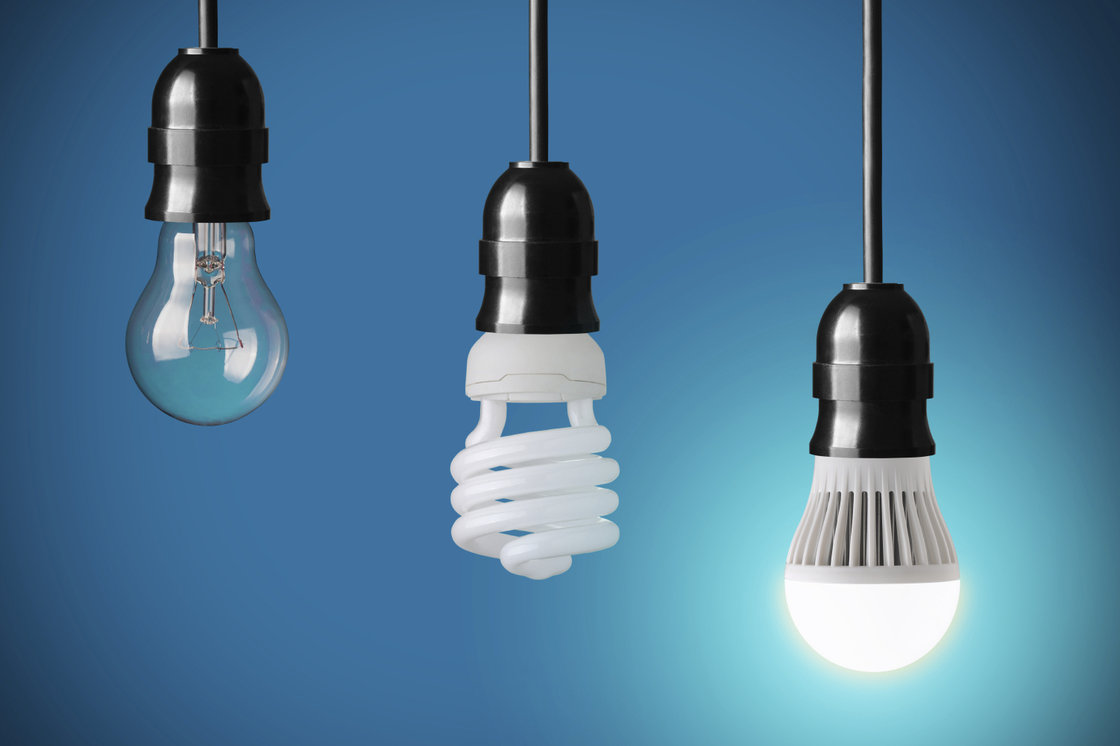
(From left) Incandescent, CFL and LED light bulbs. Many people are finding that choosing the right light bulb has a steep learning curve.
From National Public Radio, an update to the ongoing knowhow required to change a lightbulb efficiently (click the image above to go to the podcast):
Buying a light bulb used to be a no-brainer. Now it’s a brain teaser; the transition to more energy-efficient lighting means choosing from a dazzling array of products.
We’ve long identified bulbs by their wattage, but that is actually a measure of electricity, not the brightness of a bulb. The amount of light a bulb generates is measured in lumens.
An incandescent 60-watt bulb, for example, gives off 800 lumens of light. And LED bulbs, which are more energy efficient than their incandescent counterparts, can deliver the same amount of light using as little as 10 watts.
The Environmental Protection Agency says that if every household replaced just one incandescent bulb with an “Energy Star”-rated LED or CFL (compact fluorescent), Americans would save close to $700 million per year in energy costs.
But with so many types of bulbs with different price points and life spans now on the market, many consumers are confused.
When we asked for your questions about light bulbs, we got an earful. So we called in Noah Horowitz, director of the Natural Resources Defense Council’s Center for Energy Efficiency, to answer your most frequently asked questions.
(We should note that Natural Resources Defense Council, a nonprofit environmental organization, is a strong backer of energy-efficient lighting. It receives a small percentage of funding from government grants, including one from the EPA Energy Star program to accelerate the adoption of energy-efficient equipment.)
For even more information about light bulbs — the different types available, how long they last and what they cost over the life of the bulb — check out our guide to changing light bulbs.
Why do some CFLs die so quickly? The whole seven-year life thing seems random. I have some bulbs that last years but others that die within a year.
As not all CFLs are created equal, only buy those that have the Energy Star logo on them. Those bulbs are not only efficient but also meet the Environmental Protection Agency’s rigorous performance requirements and must pass various tests including longevity. Switching your CFL on and off frequently may shorten its life. Additionally, CFLs may not turn on or reach their full brightness in really cold temperatures.
Everyone I’ve talked to says they just throw dead CFLs in the trash. Isn’t this a problem for landfills? Are we going to start hearing about dangerous mercury levels in the ground and water in a few years?
CFLs have very low levels of mercury in them, now as low as 2 mg per bulb. Consumers should take advantage of free CFL recycling programs that are offered by leading retailers such as Home Depot and Lowe’s. You should also be aware that while incandescent bulbs do not contain mercury, they cause a lot more mercury to be emitted into the environment from coal-burning power plants, since they use four times more energy than a CFL to produce the same amount of light.
I have at least three lamps that use a three-way bulb (50/100/150), and I like having the option in terms of brightness. Is there a CFL or LED version of the three-way bulb?
If you want to have different levels of light and use an energy-saving bulb, you have two great choices. If you have a three-way socket, you can buy a three-way CFL which will offer low, medium and high light output, just like your old incandescent bulb did. If your fixture is dimmable, almost all LEDs are dimmable and you can enjoy even more flexibility.
Are there CFLs or LEDs for candelabra bulbs? What about globe-shaped bulbs for my bathroom vanity?
The great news is there is an energy-efficient CFL or LED for just about every socket. These include candelabra or flame-shaped bulbs, as well as the round globe-shaped bulbs that are often used in the bathroom vanity over the sink. Candelabra and globe CFLs have been around for years, and LED models are coming on line now, too.
I have some sockets that take nothing higher than a 60-watt bulb. If I use an LED or CFL, can I use a brighter bulb? For instance, a 13-watt CFL is equivalent to a 60-watt incandescent. Is it OK to use a 23-watt CFL instead? That would give me the equivalent of a 100-watt incandescent.
Fixtures have a safety rating and one should not put in bulbs that exceed the labeled rating (such as “do not exceed 60 watts”). As long as you don’t put a bulb that uses more than 60 watts in that socket you will be fine.
The good news is the energy-saving bulbs that replace a 60-watt incandescent will only use 10 to 15 watts, depending on the actual bulb you buy, and give off the same amount of light. If you want even more light, you can bump up to a 23-watt CFL that will give off as much light as the old 100-watt bulb did, while still staying below the 60-watt power cutoff. You should not, however, install a 100-watt bulb, as that could cause a fire hazard.
Are there some places in the home where you would recommend CFLs over LEDs or vice versa, such as in outdoor fixtures that are exposed to temperature extremes? Or in indoor lamps?
CFLs do not work well in cold climates and may not even start, so are not a good choice for the porch light or other outdoor sockets in cold climates. We recommend consumers select LEDs for use in recessed cans and downlights as they are better at serving as directional lights, and for sockets that are connected to a dimmer.
For those bulbs that are not used very often and are not switched on and off frequently, CFLs are probably your best bet. Conversely, put LEDs in hard-to-reach sockets, as they last up to 25 years (at three-hours-per-day usage), and you’ll avoid the hassle of having to change the bulb for a really long time…
Read the whole article here.
 Organikos
Reblogged this on Jugraphia Slate.