Alexander F. Yuan/AP Images
This article, in the Atlantic, at first seemed to have nothing to do with our core themes of community, collaboration or conservation, but reading it to the end, we see that on the contrary there is a strong link. All three of those words are closely connected to education, which is closely connected to economic opportunity, which is closely connected to the feasibility of conservation, our deepest concern. Plus, many in our realm can attest to childhood mathematical experiences, many unpleasant, that might not after all be required to develop aptitude and appetite for what is after all just another language:
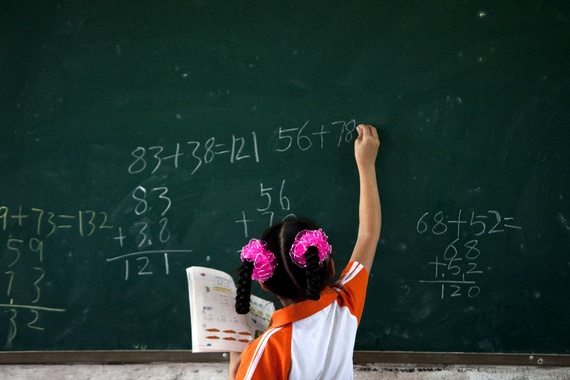
The familiar, hierarchical sequence of math instruction starts with counting, followed by addition and subtraction, then multiplication and division. The computational set expands to include bigger and bigger numbers, and at some point, fractions enter the picture, too. Then in early adolescence, students are introduced to patterns of numbers and letters, in the entirely new subject of algebra. A minority of students then wend their way through geometry, trigonometry and, finally, calculus, which is considered the pinnacle of high-school-level math.
But this progression actually “has nothing to do with how people think, how children grow and learn, or how mathematics is built,” says pioneering math educator and curriculum designer Maria Droujkova. She echoes a number of voices from around the world that want to revolutionize the way math is taught, bringing it more in line with these principles.
The current sequence is merely an entrenched historical accident that strips much of the fun out of what she describes as the “playful universe” of mathematics, with its more than 60 top-level disciplines, and its manifestations in everything from weaving to building, nature, music and art. Worse, the standard curriculum starts with arithmetic, which Droujkova says is much harder for young children than playful activities based on supposedly more advanced fields of mathematics.
“Calculations kids are forced to do are often so developmentally inappropriate, the experience amounts to torture,” she says. They also miss the essential point—that mathematics is fundamentally about patterns and structures, rather than “little manipulations of numbers,” as she puts it. It’s akin to budding filmmakers learning first about costumes, lighting and other technical aspects, rather than about crafting meaningful stories.
This turns many children off to math from an early age. It also prevents many others from learning math as efficiently or deeply as they might otherwise. Droujkova and her colleagues have noticed that most of the adults they meet have “math grief stories,” as she describes them. They recall how a single course—or even a single topic, such as fractions—derailed them from the sequential track. She herself has watched more than a few grown-ups “burst out crying during interviews, reliving the anxieties and lost hopes of their young selves.”
Droujkova, who earned her PhD in math education in the United States after immigrating here from Ukraine, advocates a more holistic approach she calls “natural math,” which she teaches to children as young as toddlers, and their parents. This approach, covered in the book she co-authored with Yelena McManaman, “Moebius Noodles: Adventurous math for the playground crowd,” hinges on harnessing students’ powerful and surprisingly productive instincts for playful exploration to guide them on a personal journey through the subject. Says Droujkova: “Studies [e.g., this one, and many others referenced in this symposium] have shown that games or free play are efficient ways for children to learn, and they enjoy them. They also lead the way into the more structured and even more creative work of noticing, remixing and building mathematical patterns.”…
…She and her colleagues are striving to empower local networks and enhance accessibility on all fronts: mathematical, cultural and financial. They have made their materials and courses open under Creative Commons, and designed activities that require only readily available materials.
“The know-how about making community-centered, open learning available to disenfranchised populations is growing,” Droujkova notes, citing experiments by Sugata Mitra and Dave Eggers. Online hubs can connect like-minded community members, and online courses and support are available to parents, teachers and teenagers who want to lead local groups.
Droujkova says one of the biggest challenges has been the mindsets of the grown-ups. Parents are tempted to replay their “bad old days” of math instruction with their kids, she says. With these calculus and algebra games, though, “parents say they get a fresh start. … They can experience the joy of mathematical play anew, like babies in a new world.”
Read the whole article here.
 Organikos