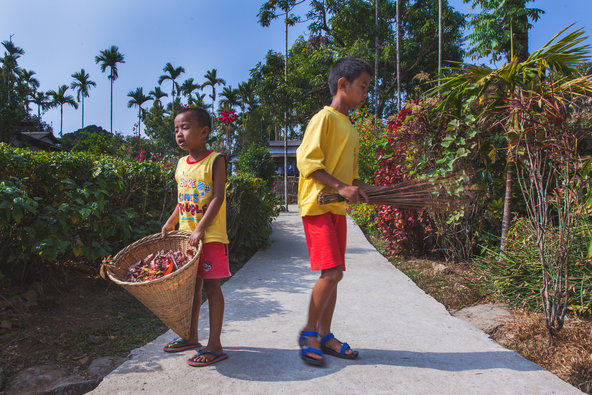
Himanshu Khagta. Children in Mawlynnong working to clean the village, where a reputation for tidiness has been both a blessing and a curse.
There is no such thing as “typical” when it comes to sustainable tourism development. By definition, each story is about that particular place. But this one, courtesy of India Ink, provides a textbook case study example of sustainable tourism development being about community self-determination. As for the notion that this comes with a built-in curse, we tend to believe that such curses are a function of and prevented by the same strategic planning, decision-making and action that blessings come from:
MAWLYNNONG, India — Anshuman Sen was barely a year out of college when, in 2005, he traveled to Meghalaya, a hilly northeastern state distant both in miles and cultural resemblance from what the locals call “mainland India.”
Mr. Sen was shooting pictures of the state’s bountiful natural wonders for Discover India, a travel magazine, when an acquaintance suggested visiting Mawlynnong, a remote village in the jungle along the border with Bangladesh that had acquired minor local renown for its fastidious cleanliness and a nearby bridge made entirely of living tree roots.
“I was only there for four or five hours,” said Mr. Sen, “but I couldn’t believe how beautiful it was, and neither could anyone at the magazine.” He had to write about it, even if he hadn’t spent a full day there.
Before Mr. Sen went home, a contact at the Meghalaya Tourism Development Forum told him that Mawlynnong was the “cleanest village in Asia,” and the impromptu — and improbable — slogan became the catchphrase of Mr. Sen’s article, published in 2005. Soon after, the BBC program “Human Planet” did a segment on the village and referenced Mr. Sen’s slogan.
Since Mr. Sen’s visit, Mawlynnong’s 90-odd families have witnessed irreversible changes as the village tries to maintain its appeal as an ecotourism destination without turning into a congested picnic spot. During the winter holiday season, hundreds of visitors arrive every day. Some are picnickers from nearby towns, while others travel from New Delhi, Kolkata and abroad.
The state of Meghalaya is no stranger to superlative-based tourism. A few ridges and valleys to the west of Mawlynnong is Cherrapunjee, famous as the “wettest place on Earth,” despite other places being demonstrably rainier.
The residents of Mawlynnong had two major advantages over Cherrapunjee. First, having developed later, Mawlynnong has paid attention to what went wrong at Cherrapunjee, where outside developers have set up huge resorts and tourism revenue goes to tour companies and a few favored restaurants and shops. Second, Mawlynnong’s claim to fame is within the residents’ control, not dependent on the weather…
Read the whole story here.
 Organikos
My wife and I had visited the area during four years ago (Sohra, which is not too far from Mawlynnong. We have experienced the beauty of the living root bridges but the place was pristine. Sad to hear that it has become another trash can.
On a related note we just returned from Agra and the Taj Mahal should be renamed as Trash Mahal.
Hi Amar, It’s unfortunate that funding for upkeep doesn’t come along with World Heritage status, so often the honor is as much a curse as a blessing, despite what appears to be local government’s best efforts to keep the areas clean. Thanks again for stopping by–we hope to see you again soon!