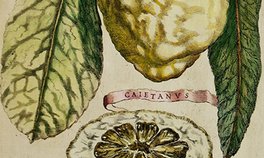
From Plate 205: Limon Caietanus by Giovanni Battista Ferrari (1584-1665)
Helena Attlee
THE LAND WHERE LEMONS GROW
The story of Italy and its citrus fruit
272pp. Particular Books. £20.
978 1 84614 430 2
The views, not to mention recent temperatures, lead most guests to sit outdoors with the breeze on the deck, on either the ground level or mezzanine, watching the fishermen haul in their catches, or the tug boats, or the ferries. 51 is alive with citrus in these sea level summer days and evenings, starting with a tall glass of iced minted-lime cooler, continuing with a chilled avgolemono soup; and so on. Clarissa Hyman, a freelance food and travel writer, catches our attention with this book review in the Times Literary Supplement:
A paradox pervades the Sicilian citrus groves and gardens. The scent is intoxicating but too often the fruit lies rotten on the ground, unwanted and worthless. In this maddening, singular island, where they say the sun drives you crazy and the moon makes you sad, the irony is your breakfast orange juice will most likely be diluted, long-life concentrate from oranges grown in Brazil.
Helena Attlee acknowledges the complexities of international trade in The Land Where Lemons Grow: The story of Italy and its citrus fruit, her fascinating grand tour of the citrus-growing regions of Italy. Her focus is less on global agro-economics than on the history of the fruit in its adopted home, and the migration of waves of citrons, sour oranges, lemons, sweet oranges and mandarins to the welcoming soil of Mediterranean Europe.
A distinguished garden writer, Attlee fell under the spell of citrus over ten years ago and the book, like the eleventh labour of Hercules to steal the golden fruit of the Hesperides, is the result. She writes with great lucidity, charm and gentle humour, and wears her considerable learning lightly. The section on the groundbreaking work of the seventeenth-century taxonomist Giovanni Battista Ferrari is particularly engrossing. The subject is challenging: the citrus family is notorious for wanton promiscuity and the species mingle freely until identification and classification (of which there are several systems) become as absurd as anything conceived by Pirandello.
Attlee has chosen a meandering geographical route which can feel a bit random in spite of the inclusion of a timeline, but it is a road map to Goethe’s “land where the lemon trees bloom” that generally works well. Personal stories are interwoven with historic and horticultural detail, vivid travellers’ tales and a few recipes: the pasta with orange and lemon peel sounds particularly alluring; less so Bartolomeo Scappi’s sixteenth-century tortoise pie (the key is the sour orange juice).
The romantic journey in search of the Italian soul of citrus takes her from the Florentine gardens of the Medici to the lemon-tree terraces of Amalfi, the shores of Lake Garda, the Ligurian Riviera, the citron and bergamot groves of Calabria, and the ravishing blood oranges of Catania. Along the way, there are some splendid experiences such as the mayhem of the annual Battle of the Oranges in Ivrea, marmalade-making on an aristocratic Sicilian estate, and a surprising encounter with Hasidic Jews who travel to Calabria every year to supervise the harvest of Diamante citrons for the festival of Sukkoth.
Attlee recognizes both the glamour of the fruit and its erotic blossom as well as its sadness. She describes the perfume as bright and carefree, “the kind than an adolescent might wear to her first party. But it has depth and below its innocence is something cloying and almost fetid, like the stale air in an elderly actress’s dressing room”. She recounts the story of the football tournaments in Reggio Calabria, as originally told by Ferrari, where oranges were used “instead of balls in trivial and foolish play”, flashing gold through the air. One shares her delight as a Ligurian citrus grower instinctively mirrors the instructions given by Ibn al-Awam in his twelfth-century Book of Agriculture when faced with a tree reluctant to bear fruit (threaten it with an axe)…
Read the whole review here.
 Organikos
Good writing – both review and the book – all well observed. Most beautiful of fruits – most useful?
Pingback: Burn Calories, Eat What You Want | Raxa Collective