
Thanks to Carl Zimmer, a science writer we feature from time to time (and then again and again and whenever when we can) for reminding us why our youth-time go-to publication for tech-stuff is still worthy of visitation:
One morning in November 2011, trucks were roaring down the Pan-American Highway, carrying loads of ore from mines in the Atacama Desert to the port town of Caldera, Chile. The trucks screamed past a young goateed American paleontologist named Nicholas Pyenson, who was standing at the side of the road, gazing at a 250-meter-long strip of sandstone that construction workers had cleared in preparation for building new lanes.
Pyenson, the curator of fossil marine mammals at the Smithsonian Institution, spends much of his time searching for fossils of whales. For over a year his Chilean colleague Mario Suárez had been nagging him to come to see whale fossils that had been exposed as construction workers widened the highway. Pyenson envisioned a few skull fragments wedged in a road cut—a very low priority. After completing his work at another fossil site in Chile, Pyenson finally agreed to go see the remains. And standing by the highway, he realized why Suárez had been so insistent. The road crew had uncovered not just a few whale bones but an entire whale graveyard. At least 40 prehistoric whales, some 30 feet long, were spread out before him. It would turn out to be the densest collection of fossil whales discovered anywhere in the world.
Whales may be some of the most remarkable animals in the history of life—they evolved, after all, from deerlike mammals on land and became top predators of the sea. But their fossils can be a nightmare for paleontologists. “I wouldn’t wish a whale fossil on anyone,” Pyenson says. “Especially not 40.”
Finding out what killed these creatures would require a huge amount of time and resources. A team of paleontologists would need to document each fossil while it was still in the ground in order to gather clues to the environment in which the whales had died. But there simply was no time to undertake an on-site study of their placement because the graveyard had been found in the middle of a construction project. Pyenson got to the site, within the town limits of Caldera, with the clock already ticking. There was only a month left in the federally mandated time allotted to researchers seeking to mine fossils and relics from the construction site.
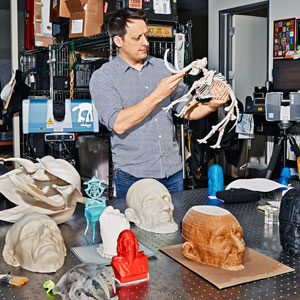
Pyenson found a solution to his quandary—one that offers a glimpse into the future of paleontology. He flew home to Washington, D.C., and returned to Chile two weeks later with Vincent Rossi and Adam Metallo, the two young men who run the Smithsonian’s 3D-digitization project. Instead of digging tools and plaster, the pair took laser scanners and cameras to the site.
The laser cowboys, as Pyenson dubbed them during the Caldera work, set up a tent over the fossils and worked for six days straight, 20 hours a day, to capture billions of pixels of data. Back at the Smithsonian, Pyenson and his colleagues used the data to re-create the site on their computers, exploring the virtual graveyard to figure out how the animals died.
And they’re able to share this knowledge in a new way—by printing high-quality replicas of the fossils. In a few months the Smithsonian is slated to unveil a 30-foot-long skeleton of one of the Caldera whales in the National Museum of Natural History. “It’s the largest 3D print of its kind in the world,” Pyenson says.
The display is a public reminder of how the ongoing revolution in digitization is changing disciplines in and out of science. The ability to preserve detailed schematic information has always been important—think of sketches and blueprints—but modern scanning technology can capture exact details for later fabrication and analysis. Today, using scanning technology, engineers in different parts of the world can collaborate in real time on ever-changing vehicle designs, customers can create parts on demand from supplier schematics, and surgeons can make detailed pre-op models of individual patients.
For the Smithsonian, laser scans provide a means to share the institution’s immense collection with the public. In 2013 the laser cowboys launched an ambitious campaign to catalog high-resolution scans of items throughout the Smithsonian’s museums—including some of Pyenson’s whale fossils—and make them navigable online. “You just say, it’s all free,” Pyenson says. “Here’s the digital avatar. Researchers, 10-year-old kids, artists—have at it.”…
Read the whole story here.
 Organikos