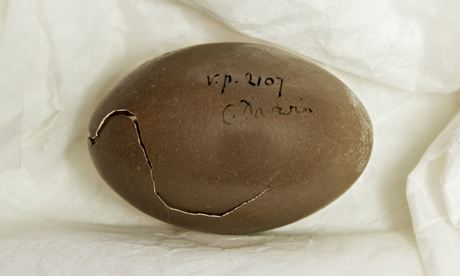
An egg mistakenly cracked by Charles Darwin is among the items in The Wonder of Birds exhibit. Photograph: Norwich Castle Museum & Art Gallery
Thanks to the Guardian for pointing us to an exhibition that will be of interest to ornithologically-inclined readers of this blog:
It is an unassuming object, a smallish, strangely glossy brown egg, and it is broken because of the carelessness of the last person you would expect – Charles Darwin.
“He squashed it into too small a box and it cracked, unfortunately,” said curator Francesca Vanke, explaining the state of the spotted tinamou egg going on display at Norwich Castle Museum and Art Gallery.
The object is the only known surviving egg from Darwin’s HMS Beagle voyage during the 1830s. Probably drawn to its glossy sheen, Darwin signed it C. Darwin and brought it back to Britain after collecting it in Uruguay.
The egg was discovered by a volunteer in the collections of the University Museum of Zoology in Cambridge five years ago and goes on display in Norwich as part of a summer art show exploring the cultural impact of birds.
“It is a coup,” said Vanke, “but we have lots of coups.”

John James Audubon (1785-1851), Hawk Pouncing on Partridges, c. 1827 Photograph: Norwich Castle Museum & Art Gallery
Around 220 items are on display, including works by major artists integrated with taxidermy from the museum’s collections.
The gallery is particularly pleased to have on display Holbein’s A Lady with a Squirrel and a Starling, on loan from the National Gallery, because the sitter was recently identified as Lady Anne Lovell, whose family owned a house in East Harling, Norfolk. Other highlights include a John James Audubon oil painting, Hawk Pouncing on Partridges, Picasso’s 1949 Dove and a beautiful 4,000-year-old Babylonian stone duck – “when you ask people how old do you think it is they say 1930s,” said the show’s other curator, David Waterhouse.
Vanke is the keeper of art while Waterhouse is curator of natural history, responsible for the dozens of stuffed birds in the show, everything from an Andean condor to a tiny hummingbird.
He said there were 20,000 in the Norwich collection. “Because so many are in store a lot of these haven’t been on display for a hundred years, so this is a real opportunity to conserve them and get them in good enough condition for the next 100 years. It has been wonderful for me to get them out.”
Read the whole article here.
 Organikos