Guest Author: Virginia Carabelli
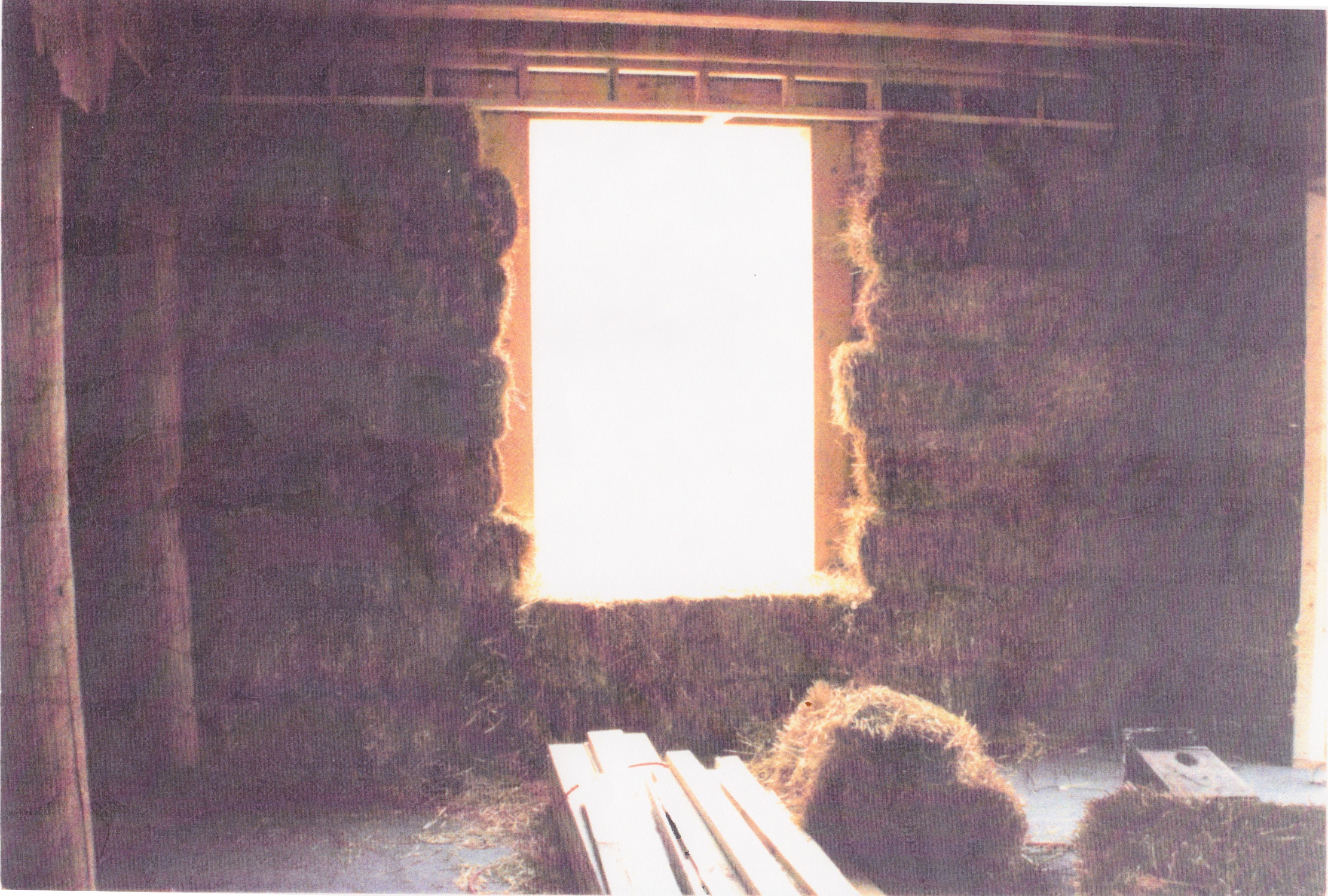
Before
In case you missed the first part of this post, click here.
At this point, let me get the three things that may be on your mind out of the way, before I move to introduce the building technique, without getting too technical.
1. Fire – Fire needs oxygen to burn, a compacted straw bale + encasing in cement or mud plaster offers no oxygen for fire to take hold. Try and burn your phone book as is (do they still make them?) and you’ll see what I mean. At worse, it will smolder.
2. Pests – Straw is like a little stalk of bamboo, in a way. It is the stem of grains whose function is to carry nutrients to the head. It has no nutritional value, protein, etc., so bugs are not very interested in it—they prefer hay or alfalfa. In fact, straw makes excellent bedding for animals because it’s not “buggy,” it does not decompose easily, and it keeps them dry. It’s wonderful in the compost pile to aerate it, precisely because it does not decompose easily. We don’t know what to do with all this straw left over from grain harvests (wheat, oats, barley, rice etc.). So we burn it. It is estimated that over a hundred million tons of straw are produced in the US each year, and much of it is burned with disastrous consequences for air, soil, and water. But to return to the pest concern: once straw bales are encased in stucco, it would be pretty hard for a mouse to break through that stucco and then dig himself into a tightly compact bale…even Mighty Mouse wouldn’t get very far! Mice like double walls; hollow, dark spaces.
3. Moisture – All building materials, even cement, are susceptible to moisture damage over time if incorrectly used. The key is to build well, with foundations and roof overhangs appropriate to your climate and conditions. Straw bales are no different. In fact, the relationship between straw bales and cement plaster is a very good one, since the plaster pulls out the moisture as it dries. Remember, straw does not decompose easily, so as long as a good building design is used there is no need to worry about moisture. It seems to me the issue is more psychological than logical.

After
The most important thing, and seemingly the most difficult one for many people to follow, is to KEEP IT SIMPLE! I have seen people try to “improve” straw bales or the building technique with expensive and often disastrous results. While the greed and ignorance of some contractors is to blame, it seems we have lost the capacity for simplicity. Our minds just cannot tolerate anything as good and straightforward as straw bale construction. It’s just too good to be true, there has to be a catch.
Here is a recipe for success: build a good foundation and roof appropriate to your climate, a post and beam skeleton with the material of your choice (unless you are building a small cabin than can be load-bearing), and stack the straw bales in between the two. Pin them together with rebar, run your electric wires and plumbing where you need to, wrap the structure with chicken wire, and plaster it. That’s it!
In Part 3, I’ll talk about permits and other recommendations about building structure, as well as further resources.

About the author: Eco Peace Solutions with emphasis on Straw Bales Building – Artist – Contemplator “Don’t think, don’t make effort. In between the two is the diamond” Papaji – Sri Hariwansh Lal Poonja
 Organikos