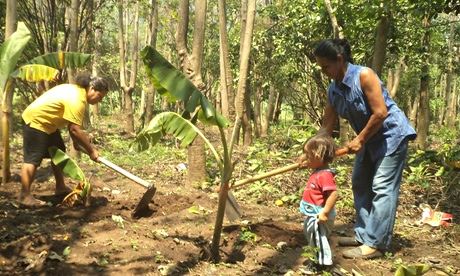
Salvadorans Elsy Álvarez and Maria Menjivar, with her young daughter, plant plantain seedlings in a clearing in the forest. Photograph: Claudia Ávalos/IPS
We have normally emphasized the word collaboration in conjunction with the conservation initiatives carried out by communities. This article in the Guardian points to research findings that indicates that another c-word, control, is sometimes key to understanding how communities reduce deforestation:
…Analysis suggests that in areas formally overseen by local communities, deforestation rates are dozens to hundreds of times lower than in areas overseen by governments or private entities. About 10-20% of global greenhouse gas emissions are attributed to deforestation each year.
The findings were released by the World Resources Institute (WRI), a thinktank, and the Rights and Resources Initiative (RRI), a global network that focuses on forest tenure.
“This approach to mitigating climate change has long been undervalued,” a report detailing the analysis says. “Governments, donors and other climate change stakeholders tend to ignore or marginalise the enormous contribution to mitigating climate change that expanding and strengthening communities’ forest rights can make.”
Researchers were able to comb through high-definition satellite imagery and correlate findings on deforestation rates with data on differing tenure approaches in 14 developing countries considered heavily forested. Those areas with significant forest rights vested in local communities were found to be far more successful at slowing forest clearing, including the incursion of settlers and mining companies.
In Guatemala and Brazil, strong local tenure resulted in deforestation rates 11-20 times lower than outside of formally recognised community forests. In parts of the Mexican Yucatan, the findings were even starker – 350 times lower.
The climate implications of these forests are significant. Standing, mature forests not only hold massive amounts of carbon, but they also suck carbon dioxide out of the atmosphere.
“We know that at least 500m hectares [1.2bn acres] of forest in developing countries are already in the hands of local communities, translating to a bit less than 40bn tonnes of carbon,” Andy White, coordinator of RRI, said. “That’s a huge amount – 30 times the amount of total emissions from all passenger vehicles around the world. But much of the rights to protect those forests are weak, so there’s a real risk that we could lose those forests and that carbon.”
White says there has been a massive slowdown in the recognition of indigenous and other community rights over the past half-decade, despite earlier global headway on the issue. But he sees significant potential to link land rights with momentum on climate change in the minds of policymakers and the donor community.
“In developing country forests, you have this history of governments promoting deforestation for agriculture but also opening up forests through roads and the promotion of colonisation and mining,” White said. “At the same time, these same governments are now trying to talk about climate change, saying they’re concerned about reducing emissions. To date, these two hands haven’t been talking to each other.”
The findings come before two major climate summits. In September, the UN secretary general will host international leaders in New York to discuss the issue; in December, the next round of global climate negotiations will take place in Peru, before intended agreement next year.
The Lima talks are being referred to as the forest round. Some observers have suggested that forestry could offer the most significant potential for global emissions cuts, but few have directly connected this potential with local tenure.
“The international community hasn’t taken this link nearly as far as it can go, and it’s important that policymakers are made aware of this connection,” Caleb Stevens, a rights specialist at the WRI and the report’s principle author, said. “Developed country governments can commit to development assistance agencies to strengthen forest tenure as part of bilateral agreements. They can also commit to strengthen these rights through finance mechanisms like the new green climate fund.”…
Read the whole article here.
 Organikos