The American Museum of Natural History is a favorite childhood and parenthood hangout of many of the readers of these pages and visitors to places where Raxa Collective does its work. Our sense of awe about the natural world often starts in an urban institution like this one. No surprise, its curators are awesome in their own right. Here is one example from the AMNH blog a few weeks back:
Q&A with Curator Melanie Stiassny
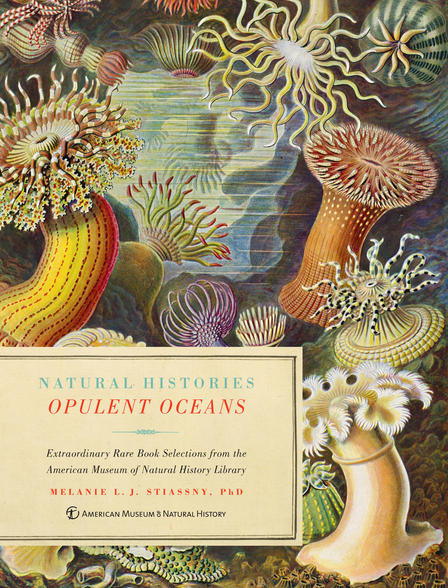
This month marks the publication of Opulent Oceans:Extraordinary Rare Book Selections from the American Museum of Natural History Library (Sterling Signature, 2014), the third in a series showcasing the spectacular holdings of the Rare Book Collection in the Museum Library. Written by Curator Melanie L. J. Stiassny, the book includes essays about pioneering biologists who studied marine life. (And like the preceding volumes—Natural Histories (2012), which inspired the current exhibition, and Extraordinary Birds (2013)—it also showcases a variety of scientific illustrations that brought new discoveries to a growing audience of experts and laypeople alike.)
We recently spoke with Dr. Stiassny, who is Axelrod Research Curator in the Department of Ichthyology, about her experiences researching the book.
Q: Are there any particular favorites among the scientists you feature?
A: One of my favorites is Johann David Schöpf (1752–1800) who was an iconic example of a polymath, adventurer, and humanitarian. He was a medical doctor, as so many of them were, fascinated by natural history, paleontology, weather patterns, botany, geology—everything. His travels through post-Revolutionary America were an amazing feat of courage and discovery.
Q: What surprised you in preparing the book?
A: I could not find a single volume in the Museum’s Rare Book Collection containing the work of a female marine naturalist. I did manage to find a few women doing great stuff but unacknowledged by the scientific community of their time. There was one botanist, William Henry Harvey (1811–1866), who went to great pains to single out and thank the women who had contributed to his work. He is a favorite too!
Q: How did you go about choosing?
A: I did a list of all the main groups of plants and animals and then looked for images first. The beauty of the illustrations, the art, is phenomenal. Using the image as an anchor, I’d research an expedition, a scientist, an artist. It was a real detective job. And so enjoyable. I’d find a name and then plunge in. I could never have done it without the internet. It opened my eyes to the fact that during the Enlightenment, the Age of Reason, having a library gave you everything. That’s why the explorers and naturalists were so often rich patricians. They had the access to the literature—and now we all have access. I realized what a field-levelling thing the internet is.
Q: The current issue of Rotunda magazine features an excerpt about ichthyologist and educator David Starr Jordan (1851–1931). What distinguished Jordan?
A: He was the founding father of American ichthyology. Just about every American ichthyologist can trace themselves to his influence. He did great things, not least helping found Stanford University. He was a prolific writer. He was a powerhouse.
Q: Why should the layperson buy this book?
A: It’s a real deal, the book, the box, the plates. (The book, packaged in a clamshell box, includes 40 prints suitable for framing.) It’s a wonderful amalgam. The art is extraordinary. It’s got something for everyone. There are so many kinds of organisms. It was important to me that each essay to have a little section on this or that group. It would be nice for a teacher to take a single essay and make a class of it.
Q: What was your personal take-away?
A: Tremendous respect for the extraordinary courage and commitment of these early marine explorers. When I am in the Congo, we have satellite phones. We go to a cybercafe once a month. They were out there for years with no communications, suffering diseases, shipwrecks—and think what they did. They traveled, wrote, did so much, and then died at 30 or 40. Schöpf was 48! I’m in awe of what they accomplished. I also felt a camaraderie with their excitement in discovery and drive to understand the natural world. That mission and excitement is very much the same for curators today. The great majority were with big museums. Their names are on the specimen jars; our names are on the jars. There’s remarkable continuity, despite our advanced technology. They had the same driving force. The same camping out under the stars.
Opulent Oceans: Extraordinary Rare Book Selections from the American Museum of Natural History Library is available at Museum shops and the Online Shop (amnhshop.com).
Thanks also to the Guardian for sharing the following images from the book:

Pierre Belon (1517-64)
This illustration of the fabled web-footed horse of Neptune closely resembles popular images of the mythical creature, which were probably seen by Belon in Roman mosaics during his travels, and documented in his book The Nature and Diversity of Fishes

Mark Catesby (1683-1749)
Catesby’s Suillus is the gorgeous hogfish (Lachnolaimus maximus), a wrasse native to the western Atlantic Ocean and much prized for its flesh. From Mark Catesby’s The Natural History of Carolina, Florida, and the Bahama Islands

Carl Chun (1852–1914)
This unusual octopus (Velodona togata) was collected off the coast of east Africa at a depth of 2,500 feet. The extensive webbing, reaching to the tip of each arm, is highly characteristic and is not found in other species. From Carl Chun’s From the Depths of the World’s Oceans: description of the German Deep-Sea Expedition
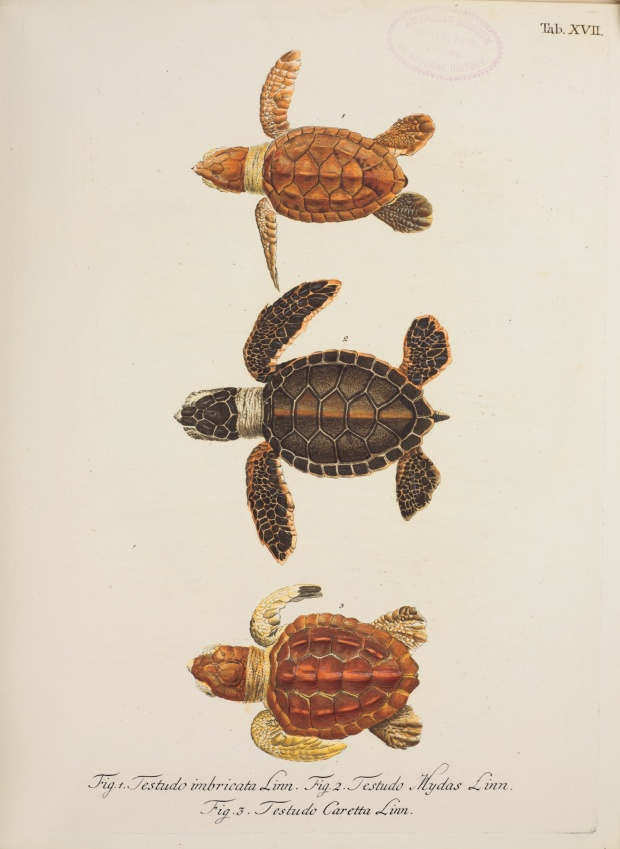
Johann David Schöpf (1752-1800). Hatchling sea turtles, from top to bottom: hawksbill, green and loggerhead. From Schopf’s Illustrated History of Turtles

More sceptical than many, Belon, nonetheless, included in his compendium some truly fantastical creatures such as this ‘sea-monk’. Later, workers suggested that the creature, which appeared in numerous other compendia of the time, was possibly based on a stranded squid of some kind
 Organikos
Pingback: Rare mushroom discovery in the Netherlands | Dear Kitty. Some blog
Pingback: The Oceans’ Invertebrates, Inveterately Out of This World | Raxa Collective