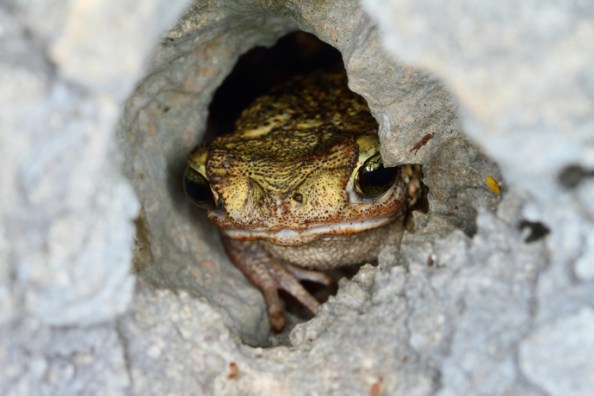
A male toad of an undescribed species hides in the limestone of the southwestern Dominican Republic. CREDIT PHOTOGRAPH COURTESY MIGUEL A. LANDESTOY
There is a reason why we highlight birds every single day. They are spectacular in many diverse ways, as well as beautiful in more ways than can be counted, and sometimes smile-inducingly odd; always exceptional ambassadors to the human world from their natural habitats, which are under constant pressure and threat. Birds may seem more charismatic than amphibians but from an ecologist’s point of view they are both extremely valuable indicators of ecosystem health. If you have been following Seth’s posts about the preparation for the Smithsonian expedition he is about to embark on, you will likely agree they would enjoy crossing paths with the team described in this story:
The southernmost corner of the Dominican Republic is dominated by limestone karst, a landscape with the look and feel of a petrified giant sponge. Snakes, small mammals, and fat, furry tarantulas live in the fissures and holes in the karst, as do toads, including one species that is not yet fully known to science. I met this new toad at three o’clock one late-fall morning, in a karst forest off a mining road near the town of Pedernales. I was with Miguel Landestoy and Robert Ortiz, a pair of freelance field biologists who have been friends since their youth, and who still spend much of their time looking for amphibians. The toad that we found—the only one we found that night—was a young female. She appeared to be content, floating in a hole filled with water and algae. Her belly was a brilliant white, her back speckled in black and green. She had big eyes spaced widely apart, like a goat’s, and a tiny upturned nose. (If not for this nose, she might have looked like a Puerto Rican crested toad, another karst-dwelling species.) As we crouched closer, she headed for the leaf litter. Ortiz noticed something about the way that she jumped—high but not long. Maybe it was a behavioral adaptation, he thought, a way to get around the karst.
The new toad species was first photographed in March, 2012, when a team of scientists, accompanied by a BBC film crew, came to Pedernales in pursuit of solenodons—ancient shrew-like mammals that also inhabit these forests. Ros Kennerley, a solenodon researcher at the University of Reading, in England, was clambering around the karst when she noticed a toad just sitting there. “I’d not seen anything similar before,” she told me, and neither had the Dominican biologists who accompanied her. They decided not to collect it, just to take pictures. It was only later, Kennerley said, “that we realized it might be something special.” The possible discovery of another toad on Hispaniola was big herpetological news. No new amphibian had been described there since the nineteen-nineties, and one of the island’s three previously identified native toads hadn’t been seen since 1971. Moreover, the finding promised to help evolutionary biologists parse the complex relationships among the species that inhabit the Greater Antilles; a toad in the Dominican Republic might have its closest relative in Cuba or Puerto Rico. But for two years after the British team’s departure no one managed to spot the new toad again—not until Landestoy and Ortiz came to Pedernales.
The two men grew up in the town of Bani, about an hour from the Dominican capital; Ortiz is married to Landestoy’s cousin. They have no institutional affiliations (not lately, anyway). Landestoy makes most of his money as a birding guide, and Ortiz began freelancing not long after a “Jerry McGuire”-style incident at Santo Domingo’s Museum of Natural History, in which he presented his bosses with an eight-page letter containing suggestions for how to do things better. They ramble around the island in Landestoy’s weathered Isuzu truck, often with Landestoy driving and Ortiz puffing anxiously on an electronic cigarette. They conduct biological surveys for the government and for mining firms, and help foreign scientists in the field. This past summer, they were working on a grant to find the toad that went AWOL in 1971. In August, feeling discouraged with their progress, they drove south to see about the mysterious new toad.
For decades, Pedernales has been known for its bauxite. The ore, a precursor to aluminum, is, in effect, a product of the karst: the chemical and physical processes that create depressions in the limestone can also cause bauxite to accumulate in them. Extracting the bauxite involves digging up the karst, something akin to taking a colossal ice-cream scoop to the earth. The U.S. company Alcoa set up mining operations in the town in the nineteen-fifties; by the late eighties, it had left behind large swaths of sunken red moonscape. The mines were largely dormant until the recent arrival of a company that exports bauxite to China. When Landestoy and Ortiz arrived in Pedernales, they were taken aback by how close the new mines came to the edge of the region’s two national parks. Even more distressing was that women were leaving the parks with bunches of logs on their heads; inside them, men were cutting down trees by the hectare. Pedernales lies across a wide dry riverbed from Anse-à-Pitres, Haiti, and thousands of Haitians work on the Dominican side of the border each day. Some had begun living in the parks, burning the tree stumps and planting beans and corn in the soot-filled holes…
Read the whole post here.
 Organikos
Une image symbole de notre société , chacun dans son trou …!!!