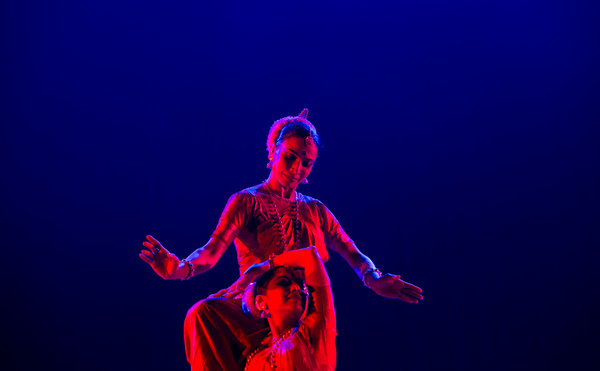
Bijayini Satpathy, top, and Surupa Sen in two duets, “Dheera Sameere” and “Kisalaya Sayana,” in Chennai, India. Credit Jyothy Karat for The New York Times
On February 4 Nrityagram, a dance troupe from India, will perform “Songs of Love and Longing” at Cornell University’s Barnes Hall. We normally do not take note of such performances at university campuses, even when the artist is from India. But this troupe is exceptional. Last week not far from Raxa Collective’s operations in Kerala, in the neighboring state, a Nrityagram dance performance led to this remarkable review in the New York Times:
A Sublime Touch, From Head to Heel
Odissi Stars at a Dance Festival in Chennai, India
JAN. 6, 2015
CHENNAI, India — Who are the greatest dancers in the world today? Most of the contenders considered in the West for this category are the roving international stars of ballet. But many of today’s finest dance artists have been performing here at the Music Academy’s weeklong dance festival, which ends on Friday. Some — all women — have touched on the sublime.
Three have been practitioners of the Odissi genre: Sujata Mohapatra, who performed on Sunday, and the two leading dancers of the Nrityagram company, Surupa Sen and Bijayini Satpathy, who presented solos and duets on Monday. (I’ll consider other festival performances next week, some no less superlative.)
Odissi is the classical idiom deriving from the eastern state of Orissa (now named Odisha). Though its roots go back 2,000 years, by the 1940s and ’50s it was scarcely known, whereas now it is taught and performed around the world. These three artists exemplify the qualities that have often made Odissi seem the most sensuously poetic of all dance idioms.
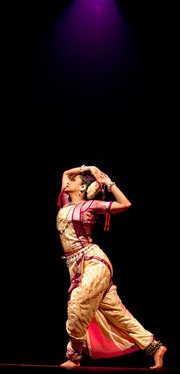
Surupa Sen of the Nrityagram company performing Odissi at a dance festival in Chennai, India. Credit Jyothy Karat for The New York Times
All three have pronounced facial and physical beauty — and in the classical dance forms of India the face itself dances and seems to speak. As these dancers move, you see Odissi’s intoxicating ability to etch sculptural shapes and then to make them gorgeously liquefy. In particular, you see the creation and change of ravishing S-bends between head and calf, like changing harmonies in music.
The Nrityagram troupe has often performed in the West. The group (consisting of Ms. Sen and Ms. Satpathy, the lighting designer Lynne Fernandez, four male musicians and sometimes other dancers, too) tours the United States most years. In New York, it has given weeklong seasons at the Joyce Theater, and on Saturday it is to perform, for the first time, in the Temple of Dendur at the Metropolitan Museum of Art — the first stop of its United States tour.
Ms. Mohapatra has given a few isolated and admired performances in New York, most recently in 2013. As yet Ms. Mohapatra, artistic director of the Guru Shradha Institute of Odissi Dance in San Francisco, enjoys nothing like the American or European reputation of the Nrityagram artists.
It’s fair to say, however, that many people around India’s complex dance world consider her the greatest Odissi stylist today. Her credentials are impressive: She is based in Bhubaneswar, the capital of Odisha (and Odissi). (Nrityagram, an hour’s drive from Bangalore, is a dance village in Karnataka.) She is also part of the most prestigious Odissi family: Her father-in-law and (for 18 years) teacher, Kelucharan Mohapatra, was the most influential of three gurus whose work was crucial in redeveloping Odissi. More crucially, among the many Indian dancers who sustain 90-minute solo dance programs, she is one of the inspiring few who raise such a recital to a vast span of both movement and spirit…
Last night they performed in New York City. The note by the New Yorker’s dance critic, if the review in the New York Times was not enough, should get you out of your seat if you happen to be in Ithaca. It makes some of us in India wish to be there.
 Organikos