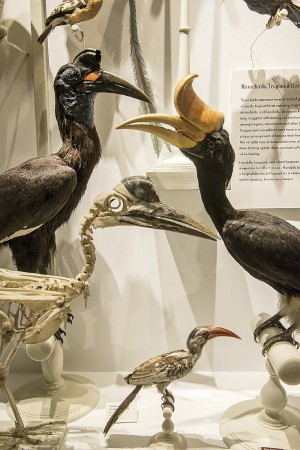
Photograph by Jim Harrison
Hornbills, including the Malaysian state bird, Buceros rhinoceros (right)
If you happen to be in Boston, and are one of our many bird-motivated readers, you may want to visit a place where birds have helped a great institution become greater:
THE GREAT MAMMAL HALL has been emblematic of the Harvard Museum of Natural History for decades. Traditionalists will be glad to know that the gorilla tirelessly pounding on his chest, the placid okapi, and the room-long whale skeleton are still in place, and birds still fill cases on the balconies that run all around the hall. But the birds are no longer solely the “Birds of North America,” as has been the case for ages. Like the University that houses them, they have become more cosmopolitan and are now “Birds of the World.”
“I’m staggered by their diversity,” said Maude Baldwin, a doctoral student
and teaching fellow in organismic and evolutionary biology, whose particular interest is hummingbirds. She and Jennifer Berglund, an exhibit developer and writer, spent many months preparing this permanent exhibition, which opened last fall. First, they refurbished the elderly display cabinets themselves. To populate the cases, they drew on the vast collection of the Museum of Comparative Zoology—350,000 bird specimens—vacuuming the dust of years from feathers, brightening eyes to restore their shine, and revealing the color and iridescence of plumage through proper lighting. Then they made everything fit—and make sense.
Read the whole article here.
 Organikos
Pingback: Libraries of Life | Raxa Collective
Pingback: A Museum You Likely Never Heard Of | Raxa Collective
Pingback: Undiscovered Species in Natural History Museums | Raxa Collective