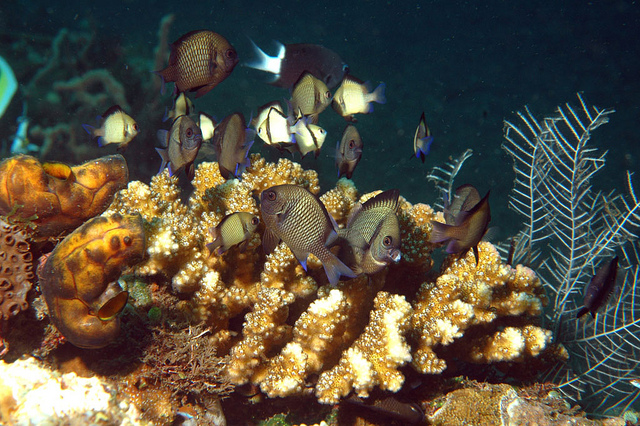
Coral garden in Indonesia. Credit: Global Environment Facility via Flickr (Creative Commons License)
We’re keeping an eye on the health of coral reefs in the Caribbean with the help of RAXA contributor Phil Karp, who has been writing specifically about the impact of invasive lionfish on the marine ecosystem. In this piece for Conservation Magazine, Sarah DeWeerdt discusses the option of taking a more active role in improving the health of corals through acclimatization:
The past several decades have been tough on the world’s coral reefs. Warming waters, ocean acidification, invasive predators, and toxic runoff have hammered these iconic hotspots of underwater biodiversity.
In response, conservationists have developed coral ‘gardens’ where young corals are reared to help rebuild damaged reefs. But some scientists worry that existing restoration strategies won’t match the pace and magnitude of the threats these animals face.
In a paper published February 2 in the Proceedings of the National Academy of Sciences, biologists from the Australian Institute of Marine Science and the Hawaii Institute of Marine biology propose a more radical approach, which they call assisted evolution.
The idea isn’t backed by much direct experimental evidence at this point, though the authors do call out examples where similar techniques have been used in other species and ecosystems. Instead, the paper is more of a think piece to encourage the conservation community to develop a ‘biological toolbox’ of strategies that will help reef-forming corals survive.
One possibility is for humans to take a more active role in acclimatizing corals to warmer waters, much as gardeners ‘harden off’ tomato plants by moving them outside for gradually longer periods in the spring. Research has shown that exposing corals to stressful but not lethal conditions such as heat or bright light can make them, and sometimes their offspring, better able to tolerate such stresses in the future.
Acclimatization may work by inducing epigenetic changes, which affect how coral genes are expressed without directly altering the sequence of their DNA. Or the process may alter the suite of microorganisms that live in conjunction with corals, especially the photosynthetic dinoflagellates called Symbiodinium, which provide energy to the corals in exchange for a safe place to life.
People could also try to manipulate coral symbionts more directly. Many different species of Symbiodinium exist, each adapted to a particular suite of climatic conditions. So coral larvae could be inoculated with stress-tolerant strains, akin to probiotics for reefs.
You can read the rest of the article here.
 Organikos
Pingback: TNC: Prairie Restoration with Wild Seeds | Raxa Collective