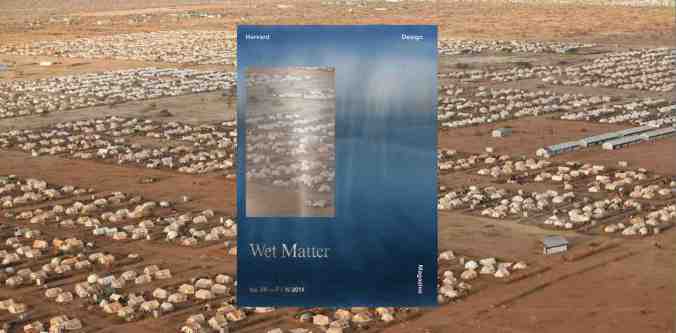
Thanks to the Harvard Gazette for bringing our attention to this magazine, published twice yearly by the Harvard University Graduate School of Design:
Making print modern
New look for Harvard Design Magazine deepens focus on ‘Wet Matter’
By Corydon Ireland, Harvard Staff Writer
In an age of bits and bytes and pixels and text on screens, Harvard Design Magazine — relaunched in a new format last year ― fervently embraces the thingness of print, the quotidian actuality of paper and ink.
The right wordsmiths were on hand to recast and renew the magazine, which is produced at the Harvard Graduate School of Design.
Editor in Chief Jennifer Sigler, who made books by hand as a child, was the editor behind “S,M,L,XL” (1995), a 1,376-page compilation of Office for Metropolitan Architecture essays, diary entries, and photographs by Rem Koolhaas and Bruce Mau — a book so popular so fast that it was counterfeited in China. “The act of turning pages has always been important,” said Sigler of her enduring fondness for print in a 2009 interview. “There’s drama in that ― suspense, engagement. It’s physical.”
Associate Editor Leah Whitman-Salkin is another champion of the magic of ink on paper. Prior to joining the magazine and the GSD, Whitman-Salkin was the editor at Sternberg Press, a leading independent art and critical theory press based in Berlin, Germany. With the redesigned magazine, she said last week, “We recommitted ourselves to print.”
Issue No. 39, F/W 2014, is “Wet Matter,” a 175-page, multi-essay, lushly illustrated exploration of what Guest Editor Pierre Bélanger describes as “the other 71 percent” of the world: that is, the oceans. Bélanger, an associate professor of landscape architecture and a close student of this “ocean nation,” calls the seas “a glaring blind spot in the Western imagination.” The oceans make up a “vast logistical landscape,” he writes, to which designers are just awakening “as sewer, conveyor, battlefield, or mine.”
In her own brief essay, Sigler — a veteran of the architecture world for two decades ― asks of designers and citizens alike, “Why this insistent focus on the dry?”…
To read the whole article, click here. To go to the Design Magazine, click the image below.

 Organikos