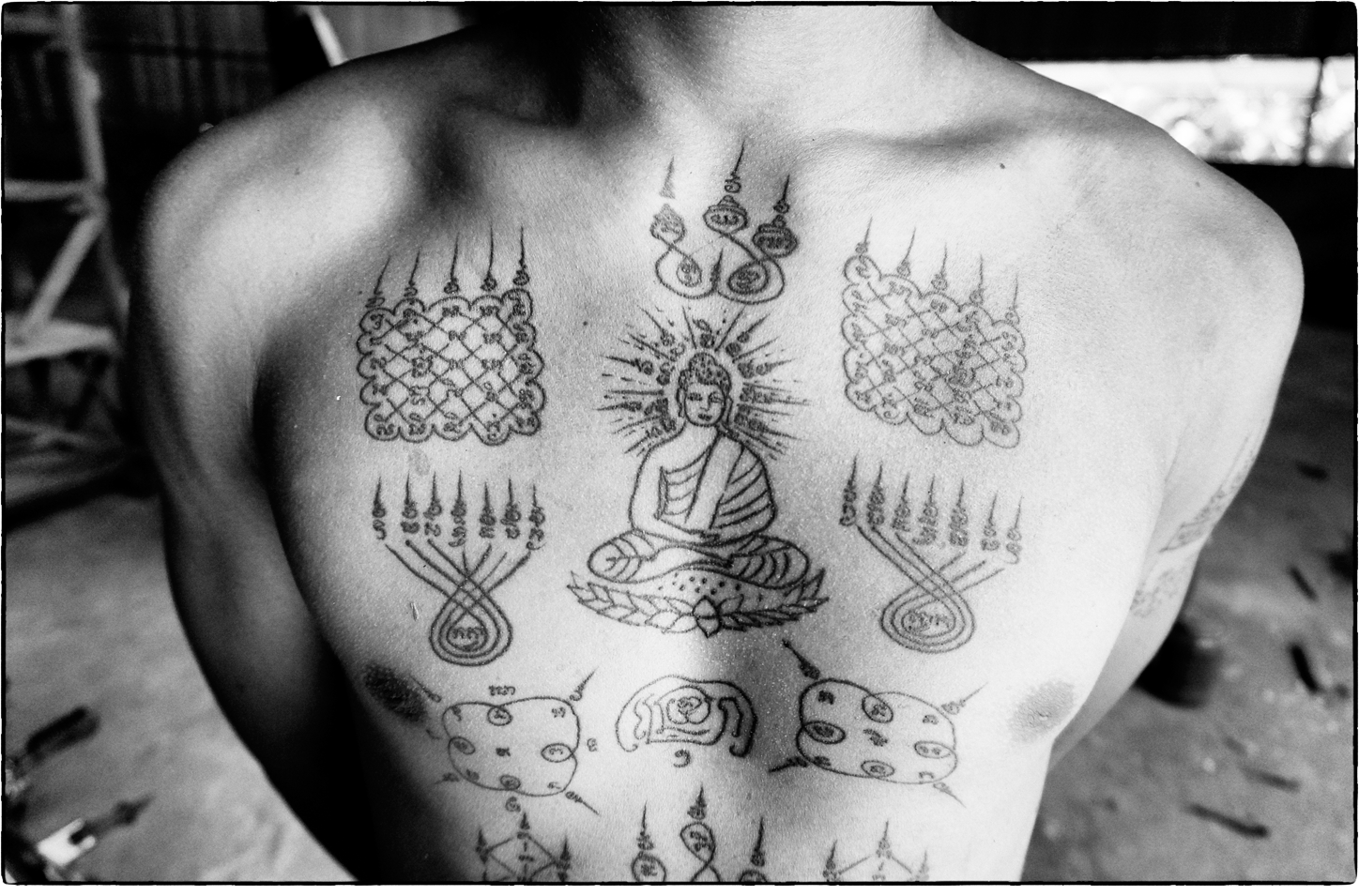
Believed to ward off bad luck, sacred tattoos or sak yant have centuries of history in Southeast Asia. PHOTO: Nathan Thompson
Magical tattoos, known as sak yant in Khmer – the language of Cambodia – are believed to render their wearers impervious to bullets, protect them from misfortune and endow them with sexual magnetism. While the tradition prevails throughout Southeast Asia, little is known about the art in Cambodia, partly because of a 1920 royal ordinance that forbade monks from tattooing and partly because the remaining practitioners were killed during the Khmer Rouge genocide and civil war. Today, traditional Cambodian sak yant is especially difficult to find because those who are still practicing the art form are reluctant to publicize their activities.
It’s clear that sacred tattoos existed long before the first Indian trading ships arrived in Southeast Asia, in around 200BC, beginning a period called “Indianisation”, when Buddhism, Brahmanism and animism bubbled in the seething mindscapes of the region for thousands of years. Eventually sak yant emerged.
Experts disagree about how this happened. Zhou Daguan, a Chinese diplomat who visited the ogival towers of Angkor in 1296, noted that the king was protected from arrow and sword wounds by takruts – tiny cylinders made from leaves of rolled metal inscribed with prayers and inserted beneath his skin (a similar practice persists in rural Cambodia: a shaman I met last year wrote mantras on thin metal leaves, rolled them up and threaded them on string, to make a protective charm). According to the late scholar of Cambodian Buddhism Ian Harris, there is a design that bears similarities to today’s sak yant engraved on one of the foundation stones of Angkor’s Bat Chum temple. It features 48 syllables arranged on a lotus blossom.
But there’s no evidence that the Brahmanic Angkor civilisation – which flourished between the ninth and 15th centuries – was the place where indigenous tattoo practice married with the Indian sacred imagination to create sak yant, even if similar practices did exist. Although temples in Thailand depict tattooed people, nothing similar has been found in Cambodia.
More about this dying tradition here.
 Organikos