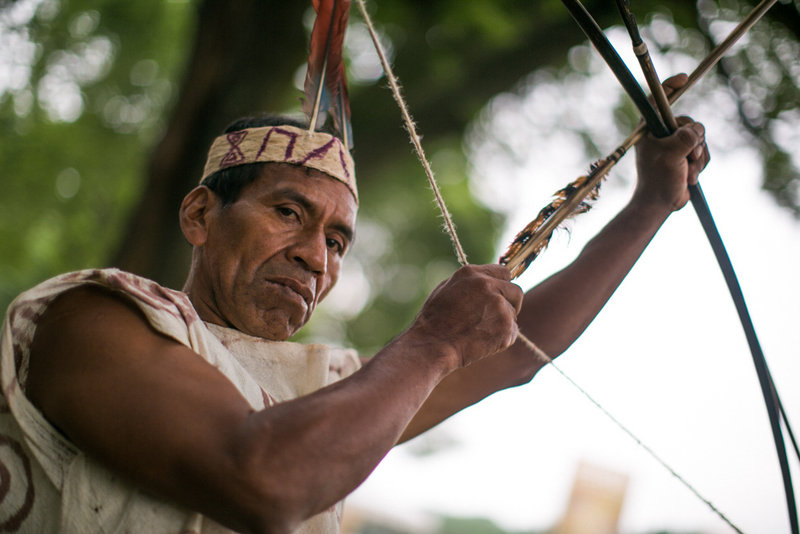
Victorio Dariquebe Gerewa displays his bow and arrow at the Smithsonian Folklife Festival in Washington, D.C. PHOTO:
Ben de la Cruz/NPR
Girls and women in the Peruvian Andes are also asking to learn — but for a different reason. They want to be able to hunt for meat and fish so they don’t have to rely on the men to bring home food.
“The world is modernizing, and women are starting to want to use the bow,” says Sergio Pacheco, a skilled archer who’s part of the tiny Wachiperi community — population estimates range from 90 to 140 — in a remote region of Southeast Peru. “They say, ‘We are just women in the family, so what happens when our father dies? We need to learn this to be able to take care of our families.'”
Pacheco was part of the Peruvian delegation that brought the cultures of their native land to Washington, D.C., for the Smithsonian Folklife Festival. And it turns out, that even in their traditional community — which they call Santa Rosa de Huacaria — the practice of archery is changing because of modern-day influences. For centuries, the Wachiperi have aimed their bows at monkeys, other mammals, fish and birds. Boys as young as 5 begin their archery lessons and learn hunting techniques. When going after a fish, Pacheco says, the trick is to aim at the fish’s head to knock it out. That way, the fish’s body isn’t damaged and the fish itself is easier to collect.
But there have been dramatic changes since the mid-20th century. “Loggers and miners have come in,” says Pacheco. “Trees are cut down and now we need to go farther out to find anything [if we go hunting]. There used to be many animals near us, but our whole area has changed.”
“Just outside where the Wachiperi live, there are more development pressures and threats,” says Hannah Stutzman, executive director of the Amazon Conservation Association. “There’s an uncontrolled expansion of agriculture, poaching, logging and mining that’s destroying habitats.”
Read more here.
 Organikos