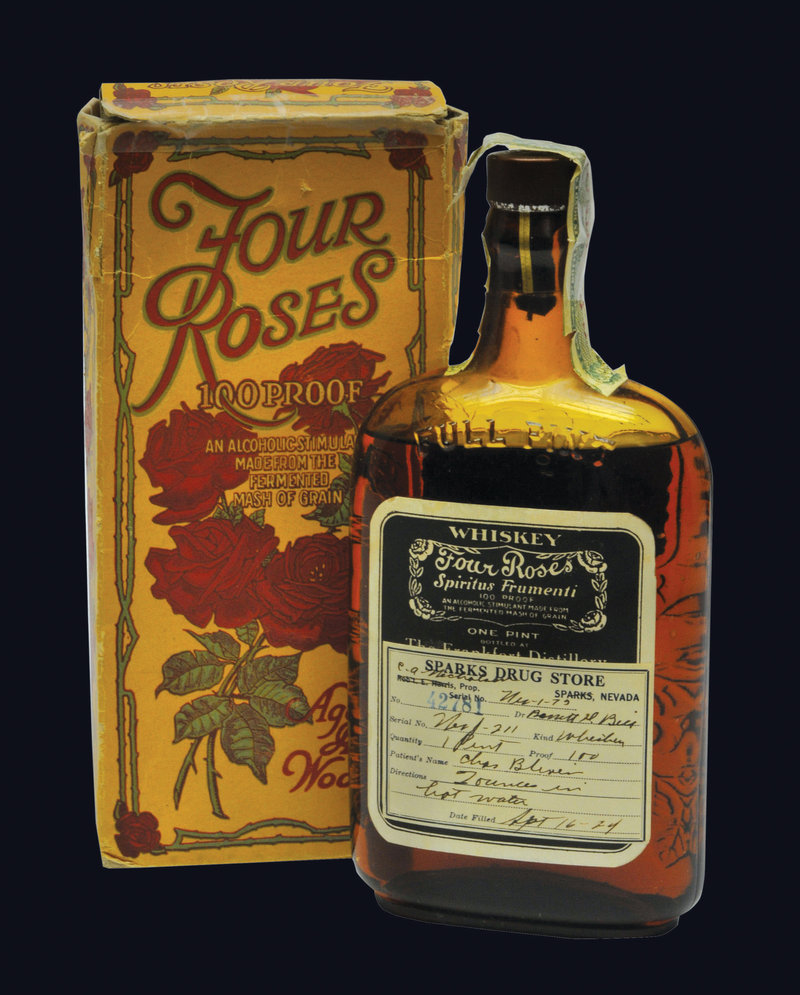
During Prohibition, whiskey could legally be sold as medicine. This particular bottle of Four Roses bourbon was prescribed to a patient in Sparks, Nev., in 1924. The label tells patients to mix 2 ounces of whiskey with hot water. PHOTO: Ten Speed Press/Four Roses
Many a book, blog and news article has been devoted to the topic of whiskey: the way it’s aged, where to drink it, how to store it and serve it or pair it with food. But comparatively little attention has been paid to how whiskey is packaged. Spirits and wine writer Noah Rothbaum felt that it was time that American whiskey labels had their day in the spotlight. His new book, The Art of American Whiskey, traces the history of surprisingly elaborate labels from the 1800s to today.
In the beginning, there was the jug.
Rothbaum says the expense of glass bottles meant that, until the early 1900s, alcohol was sold in large barrels. Bars or stores would buy these wooden barrels direct from a distiller and allow customers to come in and fill their own glass, flask or decanter with whatever was in stock. While this may have been good enough for the drinking man, it wasn’t for doctors, who “prescribed alcohol for all types of maladies,” according to Rothbaum. In 1871, Old Forrester Whiskey was the first to put its product in a sealed bottle at the distillery — ensuring that doctors and consumers knew exactly what they were getting.

Jack Daniel’s trademarked the term “Old No. 7” in 1908, although the familiar black-and-white design seen above wasn’t introduced until 1911, according to Rothbaum’s book.
When federal legislation preventing the adulteration of food or beverages went on the books in the early 1900s, the single-use bottle’s place in history was assured. Manufacturers now had impetus to make whiskey labels stand out from the crowd. Though the spirit itself was already established, in 1908 Jack Daniel’s decided to trademark the term “Old No. 7” — which it still produces today. While Jack Daniel’s may not have been the first to trademark a design element on an American whiskey bottle, the distiller was certainly an early adopter. Rothbaum finds it particularly fascinating that the company was worried about trademarking the name, since “no one actually knows what [Old No. 7] refers to.” (Though there are theories.)
Unfortunately, the history of whiskey, like that of many spirits, wasn’t always well-documented. Some of Rothbaum’s favorite labels in the book have little information to go with them. “Back in the day, each brand might sell their whiskey in multiple markets under different names or using different label art,” he explains. Yet reading between the lines often leads to some interesting findings.
Take Prohibition-era whiskeys. These were sold under the guise of medical “prescriptions,” but they didn’t come in bottles you’d expect to contain medicine. “Many had lavishly designed bottles and cardboard boxes,” Rothbaum says. “Everyone knew what the whiskey was really for.”
The Salt brings you more on the history of the amber liquid.
 Organikos