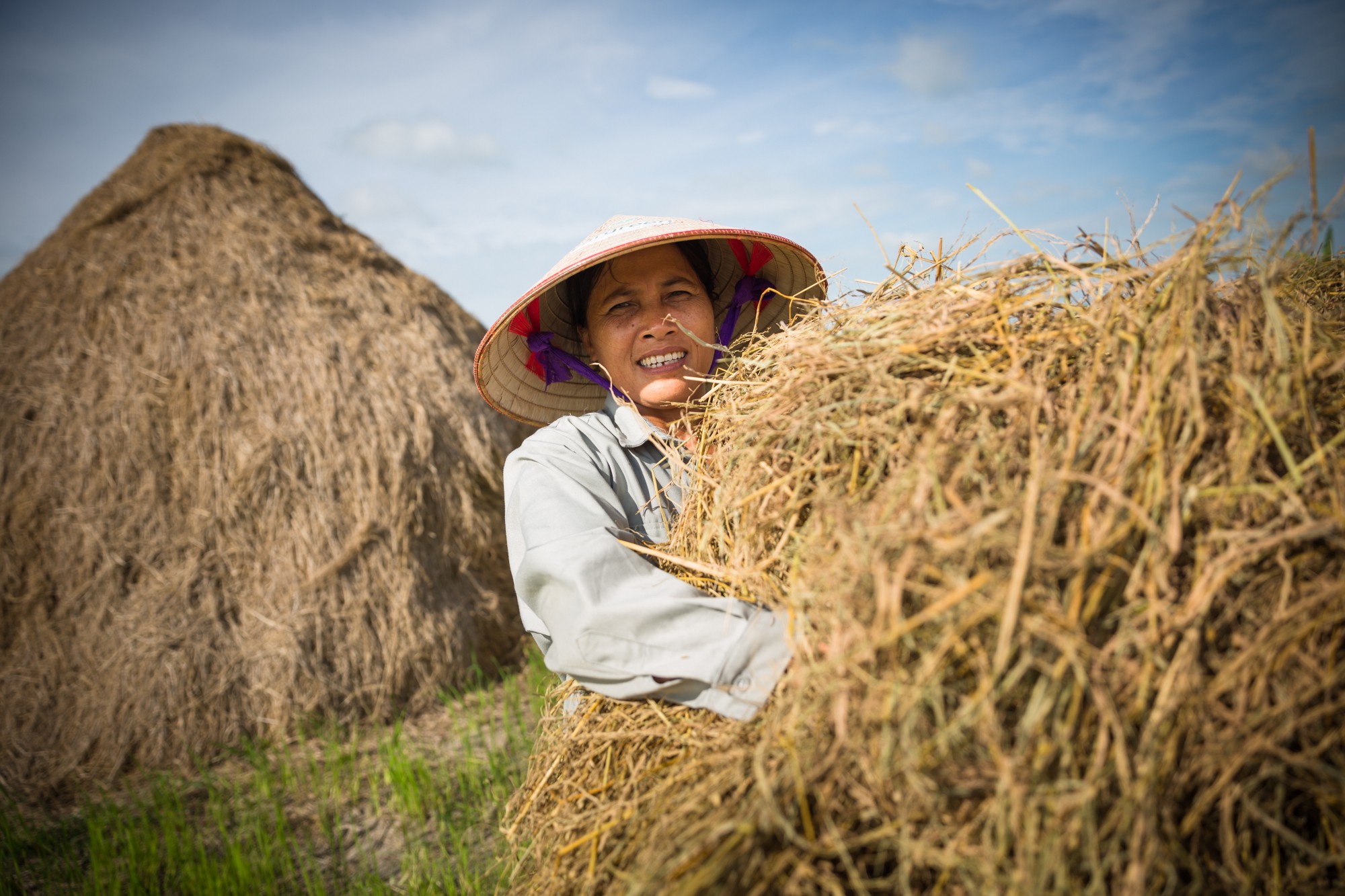
Social entrepreneur Trang Tran is teaching Vietnamese farmers how to use rice straw as a substrate to grow gourmet mushrooms, helping to reduce greenhouse gas emissions and give farmers a new source of income. PHOTO: TED
Rice straw burning is something that happens every harvest season, and it happens all around us. It’s been done for many years, and it’s considered the most convenient way of getting rid of waste. Straw is perceived as having no value — farmers just want to get it out of the way as soon as possible in order to prepare for the next crop. In Vietnam, 20 to 50 million tons of rice straw are burned annually, releasing greenhouse gases into the atmosphere. Obviously this contributes to climate change, but the more immediate problem is that local people inhale the matter, causing serious health problems in communities — particularly in babies. Poor communities are most affected, and of course they have the least money for health care.
The part of the rice plant left in the ground after the harvest is burnt right on the field. But the part left over after threshing is piled by the side of the road. There isn’t much space to store the agricultural waste once it’s been threshed, especially in Northern Vietnam, and roadsides are typically far enough away from houses that the straw can be safely burned. Some people also believe burning straw on the field helps the soil, but it’s actually really damaging because the soil gets drier and drier, and it just gets harder to farm it every year. The straw can’t just be buried because there is too much of it; composting rice straw requires a special technique and takes time. There’s a real need for the farmers to clear the field for the next round of rice cultivation — we plant two crops in Northern Vietnam and three in Southern Vietnam.
Of course, we were not the first to tackle this problem. We looked into the various ways other researchers have considered to deal with rice straw. But because we grew up in the community as well as working in development, we could see from the local perspective that the problem is far more complex than just the act of burning. You have to ask, “What is the motivation for farmers? What’s in it for them not to burn?” If there’s nothing in it for them, and burning saves time so they can prepare for their next crop, then you can’t blame them for wanting to continue.
So we tried to think a bit differently — what can we offer the farmers that would make it worth it for them not to burn? In between rice seasons, most of the farmers we work with — many of them women — have to travel to the city to find employment. They don’t have skills to compete in the job market, so all they can get in cities are low-level jobs — picking up trash for recycling and so on. If they can stay on their land and cultivate a profitable crop between rice seasons, it would alleviate a lot of hardship.
One day, we discovered in our research that rice straw can be used to grow mushrooms. We saw that it wasn’t very complex, so we bought some spawn, collected some straw to the back of the house and grew a crop.
More of this insightful story on mushrooms here.
 Organikos