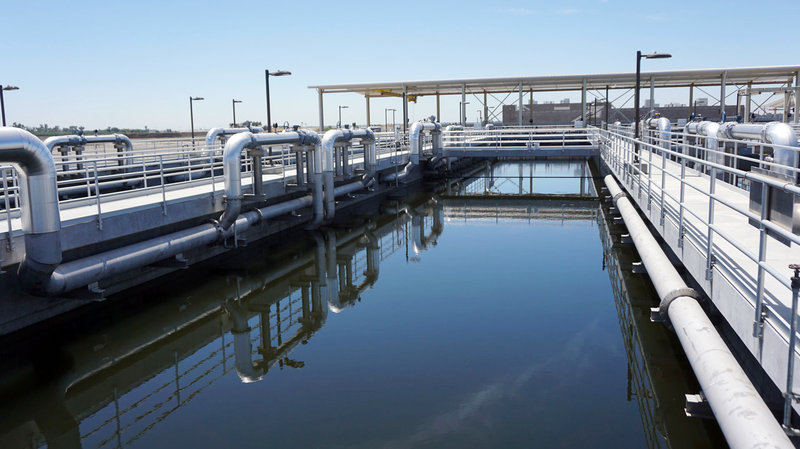
The city of Modesto’s wastewater treatment plant could supply millions of gallons of water to local farmers in California. PHOTO: Lauren Sommer
Many California farmers are in a tight spot this summer, because their normal water supplies have dried up with the state’s extreme drought. In the state’s Central Valley, that’s driving some farmers to get creative: They’re looking at buying water from cities — not freshwater, but water that’s already gone down the drain.
The parched conditions in the valley, the state’s farming hub, have been crazy. Actually, “crazy wouldn’t adequately describe what we’re going through here,” says Anthea Hansen, who runs the Del Puerto Water District in the Central Valley. “Having zero water available — we’ve been in survival and crisis mode for literally 24 months now,” she says.
The evidence is right across the street from her office: a 350-acre farm field. “This land would typically be farmed in probably tomatoes,” she says. Instead, the field is empty. Like a quarter of the 45,000 acres in the district, it’s fallowed because there’s no water. And that’s Hansen’s problem. As head of the Central Valley water district, it’s her job to find water for this farm and 150 others.
So her district turned its sights toward the wastewater treatment plant in Modesto, California, just a stone’s throw from some of the driest agricultural areas in the state. Everything that goes down the drain in the city — from 240,000 people — ends up here. And that water will be disinfected with ultraviolet light once new equipment is installed — part of a $150 million upgrade to meet new water quality requirements. It won’t be drinking-water quality, but according to state standards, it will be clean enough to use on crops. Normally, the wastewater would be disposed of in a local river, as much as 14 million gallons a day. But Modesto had an idea: Maybe someone else would want to buy it.
NPR probes if the mechanism will be a lifesaver in more hardened days of drought.
 Organikos