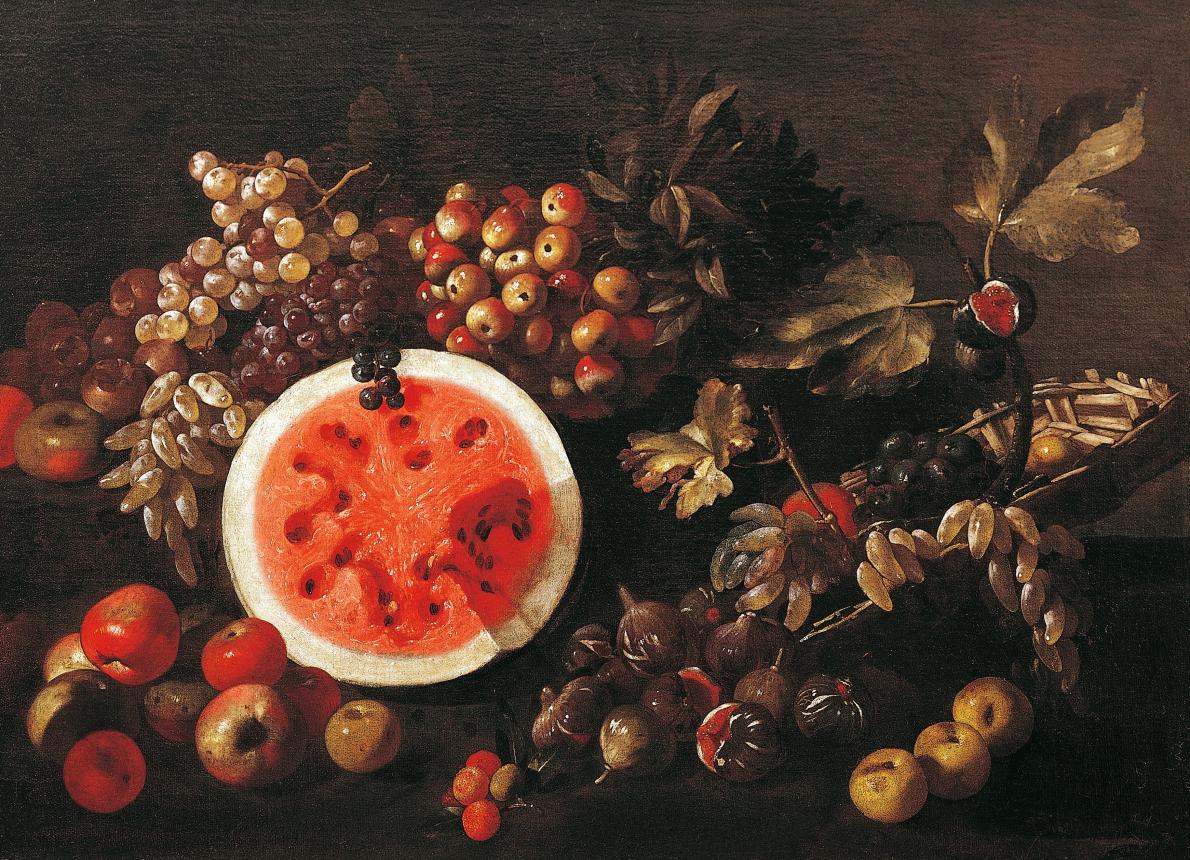
The watermelon has long inspired artists, such as Giuseppe Recco’s Still Life With Fruit (1634-1695). The first color sketches of the red-fleshed, sweet watermelon in Europe can be found in a medieval medical manuscript, the Tacuinum Sanitatis. PHOTO: Dea, A. Dagli Orti/Deagnostini/ GETTY
Watermelon may be the best picnic dessert nature ever created with its sweet juice cleverly bound inside that spongy red (sometimes yellow) matrix, and fully protected by psychedelic green rind. And no matter how you slice it, this green cannonball of nutrition is attracting scientific attention as an elixir that reduces muscle pain after workouts and a whole lot more. And the myriad ways it lends itself beautifully in the kitchen. But what about its history?
Harry Paris, a horticulturalist at the Agricultural Research Organization in Israel, has spent years assembling clues—including ancient Hebrew texts, artifacts in Egyptian tombs, and medieval illustrations—that have enabled him to chronicle the watermelon’s astonishing 5,000-year transformation.
Scientists agree that the watermelon’s progenitor—the ur-watermelon, if you will—was cultivated in Africa before spreading north into Mediterranean countries and, later, to other parts of Europe.
But, that’s where the consensus ends. Did the ancestral watermelon originally grow in Western Africa? Southern Africa? Northeastern Africa? The theories are, literally, all over the map.
“The history has been screwed up from the very outset,” says Paris, who places the blame on generations of taxonomists, stretching back to the 18th century, who hopelessly muddled melon classification.
Even the name for the modern watermelon—Citrullus lanatus—is wrong. Lanatus means “hairy” in Latin and was originally the name applied to the fuzz-covered citron melon (Cirtrullus amalus).
The citron melon, which grows in southern Africa, is one popular candidate for the watermelon’s ancient ancestor. But Paris is doubtful. He’s found evidence that the Egyptians began growing watermelon crops around 4,000 years ago, which predates farming in southern Africa.
Contestant number two is the egusi melon from western Africa. Again, Paris is skeptical. Egusis weren’t cultivated for their flesh, but for their edible seeds—the one part of the modern watermelon that nobody wants.
Paris says the true ancestor of the modern watermelon is indigenous to northeastern Africa: citrullus lanatus var. colocynthoides, known as gurum in Sudan and gurma in Egypt.
“Why go all the way to western Africa, to a country like Nigeria, when you have these watermelons still growing wild in the deserts of Egypt and Sudan to this very day?” says Paris.
Read the whole story here.
 Organikos