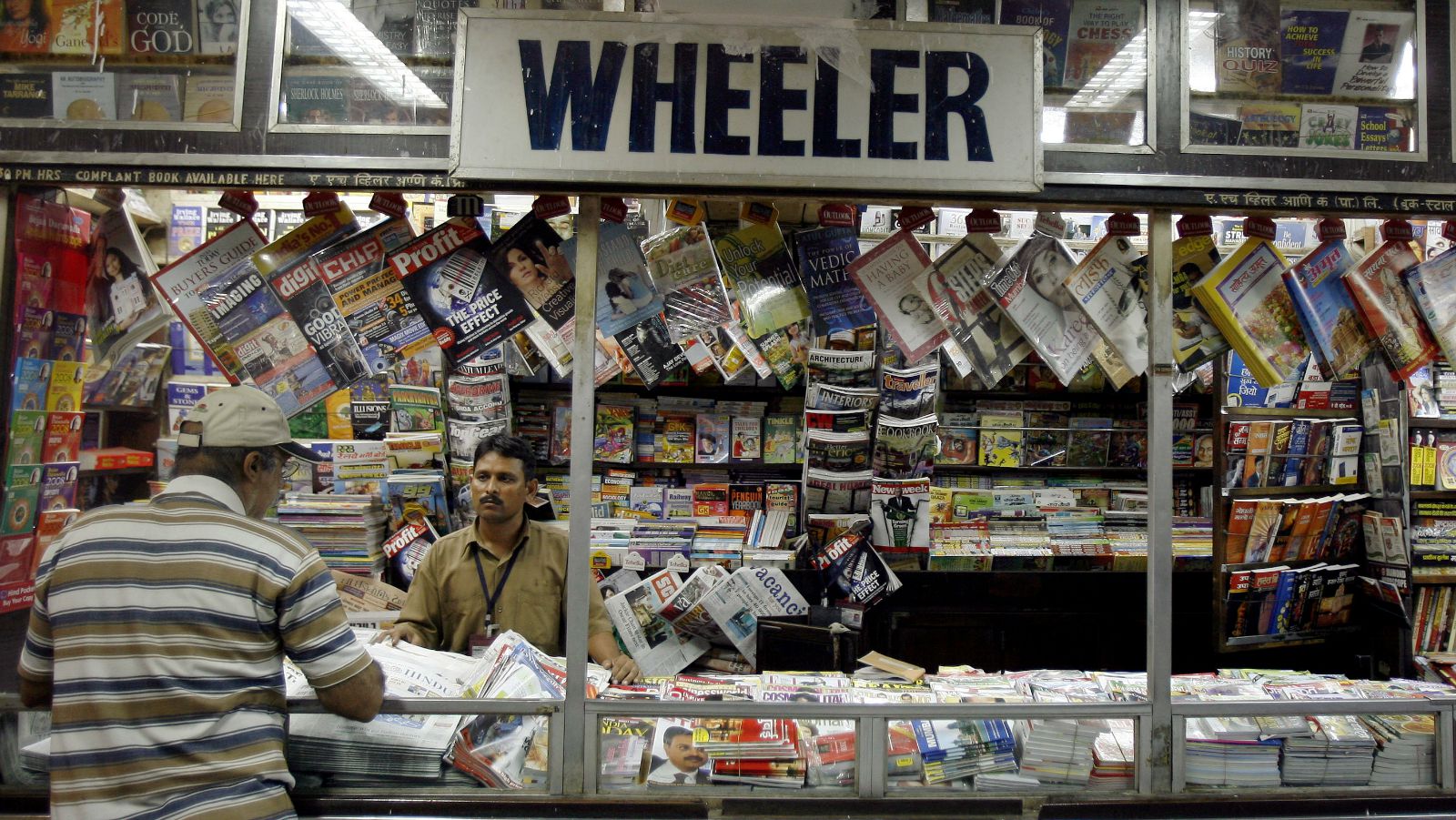
A vendor attends a customer at a railway platform at Mumbai, India. PHOTO: Reuters
You remember railway book stalls as being there since eternity. Being in the business of making arduous train journeys a pleasant affair in the company of books and newspapers. It’d be easy to assume a well-meaning civic body put them up. But as far as India goes, the country and its people owe their reading on trains to Emile Edouard Moreau, a European businessman.
In 1877 (though the date is variously given as 1874), when he was a young man of around 20, Moreau set up what would be the first of the A H Wheeler bookstalls at the Allahabad railway station. The East Indian Railways, which had commenced operations from Calcutta northward in 1854, was then expanding its operations from Allahabad to north India. The line from Allahabad to Jabalpur had already been constructed in 1867 and so for the first time Calcutta and Bombay were connected by rail via these two cities. Moreau was at that time a young employee of the managing agency Bird & Company in Allahabad.
Moreau was at that time a young employee of the managing agency Bird & Company in Allahabad. His two uncles, Paul and Sam Bird, brothers of Moreau’s mother, were partners in the company. Bird & Company was a leading labour contractor, supplying workmen to the railway company. It would soon have interests in coal, jute and other industrial enterprises.Moreau had come to India a couple of years before this. His father was a Frenchman named Auguste Moreau, and his mother was Mary Bird. Emile Moreau (not to be confused with a famous French author of the same name) was born in Oise in France, on July 11, 1856. At 15, he enrolled at the boarding school for boys Framlingham in Suffolk, and, when 17, he took a steamship to Calcutta, where his uncles were already established.
Moreau’s grandfather James Bird, who had died in 1839, had also been a bookseller. He was evidently a local poet of some repute in Yoxford, Sussex where he also encouraged other writers such as the Strickland Sisters who later moved to Canada. After the early 1850s, railway bookstalls were no longer a new feature, at least in Europe. As far back as 1852, Louis Hachette (whose name would go on to be used by the famous publishing house) had the idea of a railway library on trains plying from Paris to other regions in France. His railway library used an innovative colour scheme distinguishing books for different clientele and readerships.
Moreau’s familiarity with the railway station in Allahabad, where he lived as an employee of Bird and Co, meant that he soon noticed the demand for reading material, especially from first class passengers. As the story goes, when a friend of his, A H Wheeler, concluded that he had far too many books in his home library, Moreau volunteered to sell them from a wooden almirah at the station.
Encouraged by the results, he set up, with a few others, the A H Wheeler and Co (named after his friend, who had moved to London by then), in Allahabad. According to this report from the London Gazette, the company began as a partnership Moreau set up with Arthur Henry Wheeler and also Arthur Lisle Wheeler, along with two others, W M Rudge and the Armenian Tigran Ratheus David. It had offices in Allahabad and London.
In the late 1880s, A H Wheeler and Co (or Wheeler’s) found fame and controversy in equal measure. Moreau soon developed bigger plans as well, such as publishing. The railways had expanded and Wheeler’s bookstalls were a familiar feature at railway stations across the United Provinces, the North West Provinces and beyond in the very first decade of their existence.
Read more on how Moreau published Rudyard Kipling and other interesting facets about the man here.
 Organikos