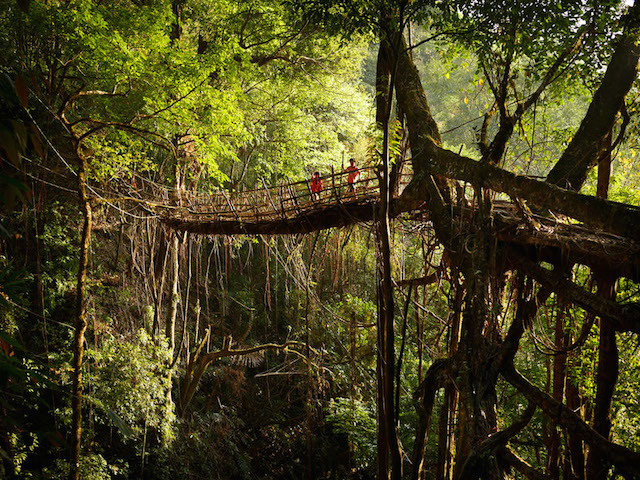
New Zealand-based photographer Amos Chapple captures a “living bridge” deep in the forests of Meghalaya, India.
Perched atop a ridge in the Khasi Hills of India’s north-east, Mawsynram has the highest average rainfall – 467in (11.86 metres) of rain per year – thanks to summer air currents gathering moisture over the floodplains of Bangladesh. When the clouds hit the steep hills of Meghalaya they are compressed to the point where they can no longer hold their moisture. The end result is near constant rain. Even the world’s biggest statue, Rio de Janeiro’s 30m tall Christ the Redeemer, would be up to his knees in that volume of water.
Unsurprisingly the area is overwhelmingly lush and green, rich with waterfalls and fascinating caves carved in the limestone by the falling water. Ten miles to the East lies the town of Cherrapunji. It’s known locally by its traditional name Sohra and is the second wettest place on earth. Its average record falls shy of Mawsynram’s by 100mm but it holds plenty of other titles. It is still the location of the wettest month and year ever recorded. In July 1861, the rainfall measured 9,300 mm (366”). Since the previous August, Cherrapunji measured a record-breaking annual total of 26,470 mm (1042”). These extraordinary wet patches are both found in the state of Meghalaya, which translates as the abode of the clouds.
While the settlements of the Khasi hills have historical rainfall records locked down, there has recently been speculation that the world’s wettest place could be elsewhere. Both the main challengers are found in Colombia but neither can technically be compared to the Indian champions.
Lloro is a town in north-western Colombia. On a farm nearby average annual rainfall between 1952 and 1954 was recorded at 13,473mm. That’s a good deal higher than Mawsynram’s average but it was made using outdated gauges so it can’t lay claim to any official title. According to weather historian Christopher C Burt, across the Andes lies another town that’s also in a bit of a puddle when it comes to extreme rainfall records. “In reality, the wettest location in the world is Puerto Lopez, Colombia with an average annual precipitation of 12,892 mm (507.56”),” he says.
Read more here.
 Organikos