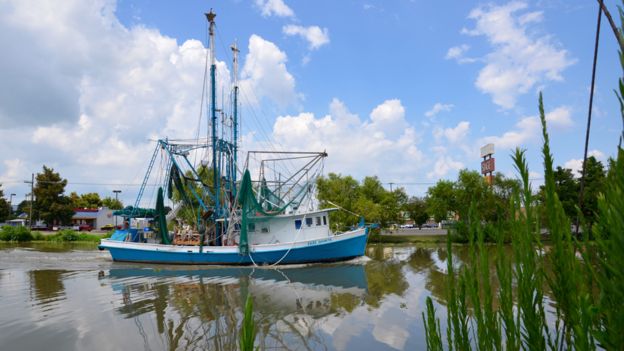
A shrimp boat heading out to fish on Bayou Lafourche. PHOTO: BBC
Cajuns are mostly descended from French immigrant ancestors. Their name comes from Acadia in Nova Scotia, Canada, where they originally settled – they were expelled by the British in the 18th Century, and many eventually ended up in southern Louisiana. What was once home to several hundred families now only counts a few permanent residents. Where there were cotton fields, there’s now open water. Where a cemetery once stood, a few last remaining tombstones are sliding into the bayou.The people here have survived hurricanes, including Katrina in 2005, and the BP oil spill in 2010. But their resilience is being tested again by a less dramatic, but no less dangerous threat – the long-term erosion of the marshes and wetlands that run all along Louisiana’s coast.
BBC brings you more on the Cajun culture that’s safeguarded by a few aging keepers:
More than a football field of land disappears every hour. As the land erodes, people in coastal communities move “up the bayou” – inland to bigger towns and cities. But as the smaller coastal communities are dispersed, traditional ways of life are under threat.
“I am the last generation of fluent speakers of French here,” say Cheramie, before launching into a demonstration of the Cajun dialect. “I think French culture is lost.”
It’s not just the language that he sees disappearing.
“Our culture of fishing and hunting and trapping, appreciating the marsh – nobody else has what we have here, eventually it’s gonna be gone. That’s what I’m scared’s gonna happen.”
One place Cajun French does survive is in song lyrics. Roland Cheramie works in a car dealership, but his real love is traditional Cajun music. “It’s music that was written by my ancestors, it tells our story,” he says. As the sun sets, he plays me some tunes on his fiddle, singing about Bayou Lafourche with a raw, heartfelt intensity.
“A Cajun is someone who loves and lives and laughs, somebody who loves to cook, loves music, loves to live,” he tells me.
He says that the movement of people up the bayou is affecting music too.
“Where you lose land you lose people and lose culture,” he says. “It’s devastating to know how strong we were as a people and now being so fragile because of erosion.”
Read the full reportage here.
 Organikos